When the primary function of communication is to convey new information, it is known as:
Solution :
The correct option is Referential function.
In communication theory, particularly Roman Jakobson's model of the functions of language, communication is analyzed based on its primary focus or goal. When the main purpose of a message is to convey information, facts, ideas, or describe a situation/context, it performs the referential function (also sometimes called the informative or cognitive function).
Here is a breakdown of why this is correct and why other options do not apply:
1. Referential Function: This function is focused on the 'context' or the referent. It is used to describe a situation, object, or mental state, providing information that can be tested for truth or falsehood (e.g., "The water is boiling" or "The meeting starts at 3 PM"). Since conveying new information is the primary goal, this is the correct classification.
2. Subliminal function: This refers to communication that operates below the threshold of conscious awareness, which is not primarily about conveying explicit new information.
3. Single task function: This is not a standard category in established communication models.
4. Differential function: This term is not used to describe the informative aspect of primary communication functions.
Completely free for students. Educators & coaching institutes get 2 months free Pro trial to create tests.
Access unlimited practice questions, detailed step-by-step solutions, and exam study materials — completely free for students.
Create and conduct professional online assessments with AI question generation, tab proctoring, and comprehensive batch management.
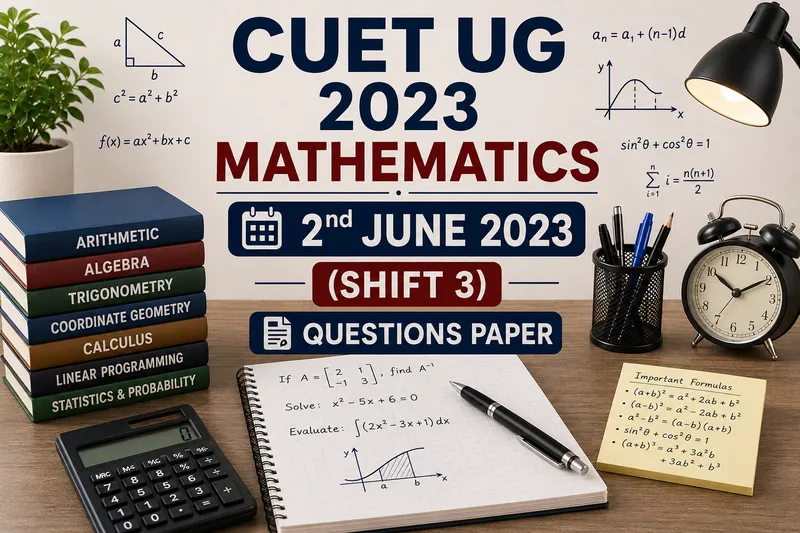
A comprehensive CUET UG Mathematics Question Paper with Solutions – 2 June 2023 (Shift 3) designed to help students practice and understand the actual CUET exam pattern. This paper covers important topics from Algebra, Calculus, Coordinate Geometry, Probability, Statistics, Matrices, Determinants, and Vectors, featuring a balanced mix of conceptual, numerical, and application-based questions. Detailed solutions are provided to strengthen problem-solving skills, improve conceptual clarity, and enhance calculation accuracy. Based on the CUET syllabus and previous year exam trends, this paper is ideal for practice, revision, self-assessment, time management, previous year analysis, and final preparation for upcoming CUET UG Mathematics examinations.
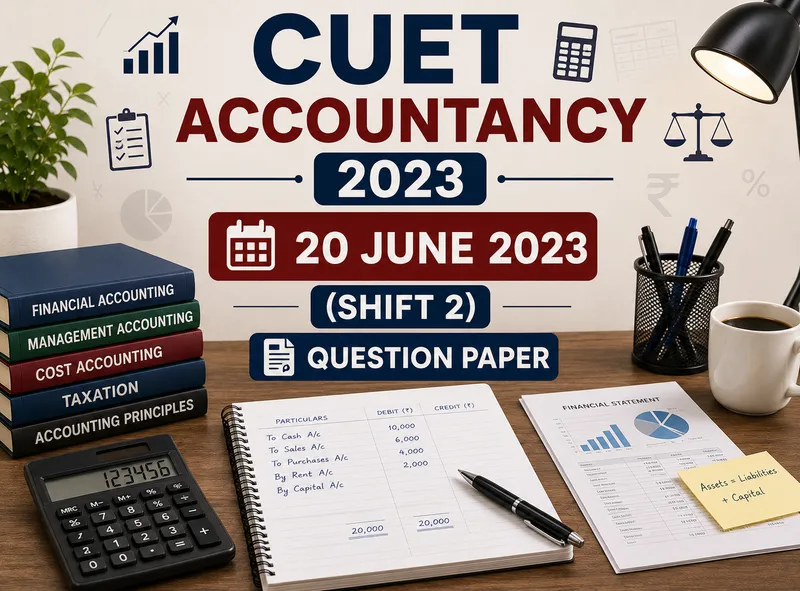
A comprehensive CUET Accountancy Question Paper – 20 June 2023 (Shift 2) designed to help students practice and analyze previous year exam patterns for effective CUET preparation. This paper covers important topics including Accounting for Partnership Firms, Company Accounts, Financial Statements Analysis, Cash Flow Statements, Accounting Ratios, and Fundamental Accounting Principles. It features a balanced mix of conceptual, numerical, and application-based questions to strengthen accounting concepts, improve calculation accuracy, and enhance problem-solving skills. Based on the CUET exam structure and syllabus, this paper is ideal for practice, revision, self-assessment, time management, previous year analysis, and final preparation for upcoming CUET Accountancy examinations.
Copyright © 2026 Combe Labs Private Limited. All Rights Reserved.