Which of the following diagrams is correct with regard to the proximal (P) and distal (D) tubule of the Nephron.
Options
 .
.
 .
.
 .
.
 .
.
Correct Answer :
.
Solution :
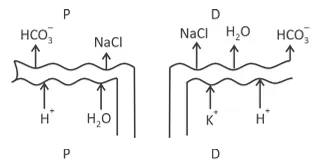
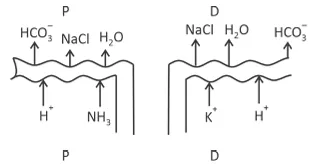
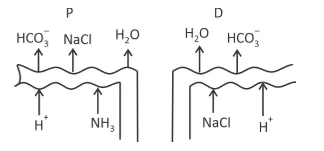
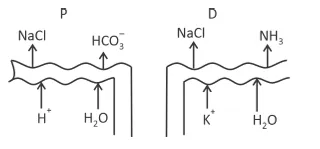
The correct diagram is shown in Option B (the second diagram, corresponding to the image containing the correct reabsorption and secretion pathways for both the proximal and distal convoluted tubules).
To determine the correct diagram, we must analyze the movement of substances (indicated by the direction of the arrows) across the epithelial membranes of the nephron's proximal convoluted tubule (P) and distal convoluted tubule (D):
1. Proximal Convoluted Tubule (P):
- Reabsorption (arrows pointing out of the tubule): The proximal tubule is the main site for the reabsorption of essential substances back into the blood. It reabsorbs about 70-80% of electrolytes and water, including sodium chloride (), water (), and bicarbonate ions ().
- Secretion (arrows pointing into the tubule): To maintain the pH and ionic balance of body fluids, the epithelial cells selectively secrete hydrogen ions () and ammonia () into the filtrate.
2. Distal Convoluted Tubule (D):
- Reabsorption (arrows pointing out of the tubule): The distal tubule is capable of conditional reabsorption of sodium ions (), water (), and bicarbonate ions () to regulate blood pressure and acid-base balance.
- Secretion (arrows pointing into the tubule): It selectively secretes potassium ions () and hydrogen ions () into the filtrate to maintain ionic homeostasis.
Comparing the provided options:
- Option A: Incorrect, because it incorrectly depicts water () entering (being secreted into) the proximal tubule.
- Option B: Correct, as it accurately matches all the physiological transport directions described above.
- Option C: Incorrect, because it incorrectly depicts sodium chloride () entering (being secreted into) the distal tubule.
- Option D: Incorrect, because it incorrectly shows water () entering the proximal tubule, and ammonia () exiting (being reabsorbed from) the distal tubule.
Access expert-curated educational resources and study materials—completely free.
Create, conduct, and manage professional online assessments with Mindyard. Perfect for teachers and institutes.
Copyright © 2026 Mindyard. All Rights Reserved.
 Set - 3-1782888548748.webp)