Which of the following is always true for LL(1) parser?
Solution :
The correct option is LL(1) is non back tracking.
To understand why this is always true, let us break down the features and definitions of an LL(1) parser step-by-step:
1. Understanding LL(1) Parsing:
The name LL(1) stands for:
• The first L indicates scanning the input from Left to right.
• The second L indicates producing a Leftmost derivation.
• The 1 in parentheses indicates using 1 lookahead input symbol at each step to make parsing decisions.
2. Non-backtracking Nature:
An LL(1) parser is a deterministic, predictive parser. When making a decision about which production rule to apply for a non-terminal, it looks at the current input token (lookahead of 1) and the top of the stack. Because the LL(1) parsing table has at most one production rule per cell (i.e., for any non-terminal and input symbol combination), the parser always knows exactly which rule to apply next. It never needs to guess or try multiple paths, meaning it is completely non-backtracking. If a cell contains more than one entry, the grammar is not LL(1).
3. Why other options are incorrect:
• "Grammar must be left factored": Left-factoring is a technique used to make a grammar suitable for LL(1) parsing if it has common prefixes. However, it is not a requirement that *all* grammars must be left-factored to be LL(1); some grammars are already LL(1) without requiring any left-factoring.
• "LL(1) parser is more powerful than SLR(1)": This is incorrect. SLR(1) is a bottom-up parser (LR family) which is strictly more powerful than LL(1) (a top-down parser). Any LL(1) grammar is also SLR(1), but not all SLR(1) grammars are LL(1).
• "Grammar must be left recursive": This is incorrect. In fact, LL(1) parsers cannot handle left-recursive grammars because left recursion leads to infinite loops in top-down parsing. Left recursion must be eliminated to make a grammar LL(1).
Completely free for students. Educators & coaching institutes get 2 months free Pro trial to create tests.
Access unlimited practice questions, detailed step-by-step solutions, and exam study materials — completely free for students.
Create and conduct professional online assessments with AI question generation, tab proctoring, and comprehensive batch management.
Prepare for GATE 2026 Civil Engineering with the latest question papers, previous year papers, detailed solutions, syllabus, exam pattern, preparation tips, mock tests, and subject-wise study material. Download GATE 2026 CE question papers with solutions in PDF format and boost your preparation for top engineering institutes and PSU recruitment.
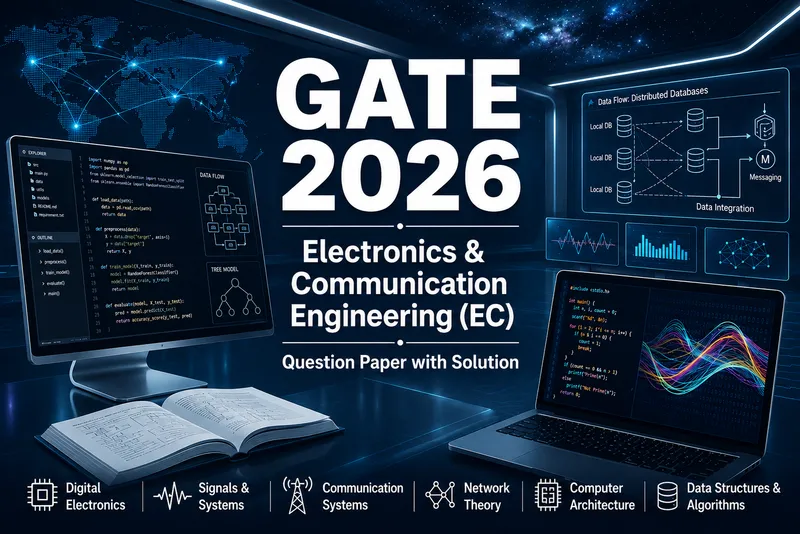
Prepare effectively for GATE 2026 Electronics & Communication Engineering (EC) with this comprehensive Question Paper with Solutions. This resource includes detailed explanations, concept-wise solutions, previous year paper analysis, and exam-oriented practice to help aspirants strengthen core subjects like Electronic Devices, Analog Circuits, Digital Circuits, Signals & Systems, Network Theory, Control Systems, Electromagnetics, Communications, and more. Perfect for revision, self-assessment, and boosting your GATE 2026 EC preparation strategy.
Copyright © 2026 Combe Labs Private Limited. All Rights Reserved.