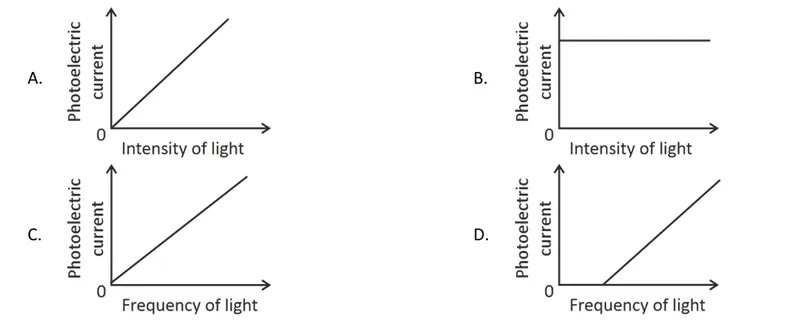
Which of the following options represent the variation of photoelectric current with property of light shown on the x-axis?
Correct Answer :
A only
Solution :
The correct option is A only.
Let us analyze the relationship between the photoelectric current and the properties of incident light shown on the x-axis in each graph:
1. Graph A (Photoelectric current vs. Intensity of light):
According to the photon theory of light, the intensity of light is directly proportional to the number of photons incident on the photosensitive plate per unit area per second. Since one photon interacts with one electron to cause photoemission, the number of photoelectrons emitted per second is directly proportional to the intensity of the incident light (provided the frequency of the light is above the threshold frequency). Since the photoelectric current is defined as the rate of flow of these emitted photoelectrons, we have:
This direct proportionality is represented by a straight line passing through the origin, which is correctly depicted in Graph A.
2. Graph B (Photoelectric current vs. Intensity of light):
This graph shows the photoelectric current remaining constant as the intensity increases. This contradicts the law of photoelectric emission, which states that current must increase with intensity. Hence, Graph B is incorrect.
3. Graphs C and D (Photoelectric current vs. Frequency of light):
The frequency of incident light determines the maximum kinetic energy of the emitted photoelectrons, not the number of emitted photoelectrons (which depends on intensity). As long as the frequency is greater than the threshold frequency, the photoelectric current is independent of the frequency of light. Thus, the current does not increase with frequency as shown in Graphs C and D. Note that Graph D actually represents the variation of stopping potential with frequency, not photoelectric current.
Therefore, only Graph A correctly represents the variation of photoelectric current.
Access expert-curated educational resources and study materials—completely free.
Create, conduct, and manage professional online assessments with Mindyard. Perfect for teachers and institutes.
Copyright © 2026 Mindyard. All Rights Reserved.