
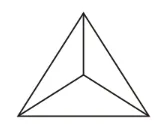
Which one of the following can be folded to form the given solid?
Options
Correct Answer :
Solution :
Correct Answer: Option 4
To determine which net folds into the given 3D solid figure, let us analyze the geometry of the target solid shown in the question:

Step 1: Identify the solid
The given 3D solid is a regular tetrahedron (a triangular pyramid). A regular tetrahedron consists of exactly 4 triangular faces that meet at edges and vertices.
Step 2: Analyze the valid net of a tetrahedron
A valid 2D net of a 3D solid must be a connected set of faces joined along full edges (hinges) that can fold without overlapping faces to fully enclose the 3D shape.
Let's evaluate the given net options:
1. Option 1:

In this arrangement, two triangles share only a single vertex point in the middle rather than a full edge line. Triangles connected only at a vertex cannot form a valid fold along an edge.
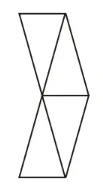
2. Option 2:

This arrangement also has triangles sharing an apex vertex and overlapping line configurations that cannot fold into a closed 4-faced tetrahedron.
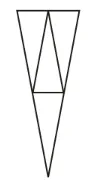
3. Option 3:

Similar to Option 1, the top and bottom sections touch only at a single point (vertex connection), which prevents edge folding.
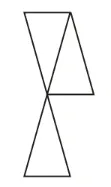
4. Option 4:

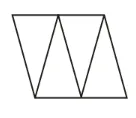
This net consists of 4 congruent triangles arranged side-by-side in a parallelogram-like strip where each adjacent pair of triangles shares a complete edge fold. Folding these 4 faces inwards brings the outer free edges together perfectly to form a closed regular tetrahedron.
Therefore, the net in Option 4 can be folded to form the given solid.
Access expert-curated educational resources and study materials—completely free.
Create, conduct, and manage professional online assessments with Mindyard. Perfect for teachers and institutes.
Copyright © 2026 Mindyard. All Rights Reserved.




