
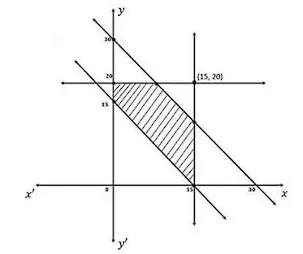
Which one of the following set of constraints does the given shaded region represent?
Correct Answer :
x + y ≤ 30, x + y ≥ 15, x ≤ 15, y ≤ 20, x, y ≥ 0
Solution :
Correct Answer:
The set of constraints that represents the given shaded region is:
Step-by-Step Explanation:
To determine the set of linear inequalities representing the shaded feasible region, we examine each boundary line shown in the graph and test the region relative to it:
1. The vertical boundary line:
The graph displays a vertical line passing through 15 on the x-axis, which corresponds to the line:
2. The horizontal boundary line:
There is a horizontal line passing through 20 on the y-axis, which corresponds to the line:
3. The upper diagonal boundary line:
This line passes through the intercepts and .
The equation of this line is given by:
4. The lower diagonal boundary line:
This line passes through the intercepts and .
The equation of this line is given by:
5. Non-negativity constraints:
Since the shaded region lies entirely within the first quadrant, both variables must be non-negative:
Combining all the derived inequalities, we get the set of constraints that represents the shaded region:
Access expert-curated educational resources and study materials—completely free.
Create, conduct, and manage professional online assessments with Mindyard. Perfect for teachers and institutes.
Copyright © 2026 Mindyard. All Rights Reserved.




