While judging a personality pageant, raters gave high scores to contestants who were already famous because of their presence in popular T.V. serials or advertisements and tended to give low scores to those who were not so popular. This phenomenon is called
Solution :
The correct option is Halo effect.
Step-by-step explanation:
1. Understanding the Situation: In the given scenario, raters are judging contestants in a personality pageant. Instead of evaluating the contestants solely based on their performance in the pageant, the raters are influenced by their pre-existing knowledge of the contestants' fame (their presence in popular T.V. serials or advertisements). Raters gave higher scores to those who were already popular and lower scores to those who were not.
2. Defining the Concept: The Halo effect is a cognitive bias where our overall impression of a person (in this case, their fame and popularity from T.V. or advertisements) influences how we feel and think about their character or other specific traits (in this case, their performance in the personality pageant). Because they are viewed positively in one area (fame), this positive impression "spills over" and biases the raters to judge their personality pageant performance more favorably.
3. Analyzing the Other Options:
- Recency effect: The tendency to recall or be influenced by the most recently presented information or experiences.
- Primacy effect: The tendency to recall or be influenced by the information presented first.
- Rosenthal effect (or Pygmalion effect): The phenomenon where higher expectations lead to an increase in performance.
None of these options describe the spillover of a general impression or a single trait (fame) onto other unrelated ratings as accurately as the Halo effect.
Completely free for students. Educators & coaching institutes get 2 months free Pro trial to create tests.
Access unlimited practice questions, detailed step-by-step solutions, and exam study materials — completely free for students.
Create and conduct professional online assessments with AI question generation, tab proctoring, and comprehensive batch management.
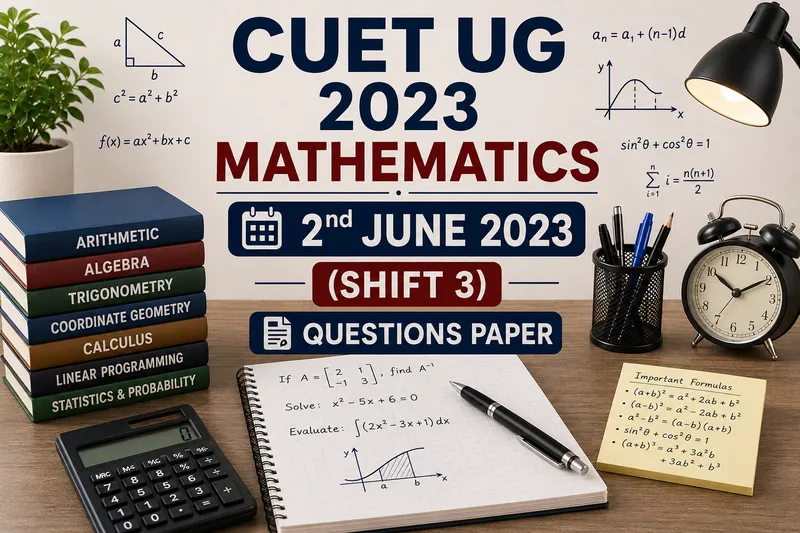
A comprehensive CUET UG Mathematics Question Paper with Solutions – 2 June 2023 (Shift 3) designed to help students practice and understand the actual CUET exam pattern. This paper covers important topics from Algebra, Calculus, Coordinate Geometry, Probability, Statistics, Matrices, Determinants, and Vectors, featuring a balanced mix of conceptual, numerical, and application-based questions. Detailed solutions are provided to strengthen problem-solving skills, improve conceptual clarity, and enhance calculation accuracy. Based on the CUET syllabus and previous year exam trends, this paper is ideal for practice, revision, self-assessment, time management, previous year analysis, and final preparation for upcoming CUET UG Mathematics examinations.
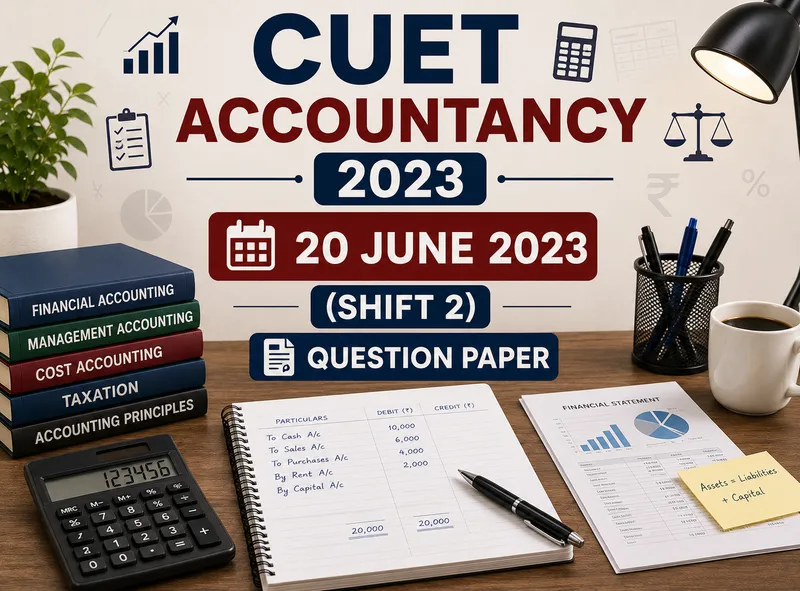
A comprehensive CUET Accountancy Question Paper – 20 June 2023 (Shift 2) designed to help students practice and analyze previous year exam patterns for effective CUET preparation. This paper covers important topics including Accounting for Partnership Firms, Company Accounts, Financial Statements Analysis, Cash Flow Statements, Accounting Ratios, and Fundamental Accounting Principles. It features a balanced mix of conceptual, numerical, and application-based questions to strengthen accounting concepts, improve calculation accuracy, and enhance problem-solving skills. Based on the CUET exam structure and syllabus, this paper is ideal for practice, revision, self-assessment, time management, previous year analysis, and final preparation for upcoming CUET Accountancy examinations.
Copyright © 2026 Combe Labs Private Limited. All Rights Reserved.