
A farmer had a rectangular land containing 205 trees. He distributed that land among his four daughters – Abha, Bina, Chitra and Dipti by dividing the land into twelve plots along three rows (X,Y,Z) and four Columns (1,2,3,4) as shown in the figure below:
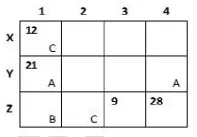
The plots in rows X, Y, Z contained mango, teak and pine trees respectively. Each plot had trees in non-zero multiples of 3 or 4 and none of the plots had the same number of trees. Each daughter got an even number of plots. In the figure, the number mentioned in top left corner of a plot is the number of trees in that plot, while the letter in the bottom right corner is the first letter of the name of the daughter who got that plot (For example, Abha got the plot in row Y and column 1 containing 21 trees). Some information in the figure got erased, but the following is known:
1. Abha got 20 trees more than Chitra but 6 trees less than Dipti.
2. The largest number of trees in a plot was 32, but it was not with Abha.
3. The number of teak trees in Column 3 was double of that in Column 2 but was half of that in Column 4.
4. Both Abha and Bina got a higher number of plots than Dipti.
5. Only Bina, Chitra and Dipti got corner plots.
6. Dipti got two adjoining plots in the same row.
7. Bina was the only one who got a plot in each row and each column.
8. Chitra and Dipti did not get plots which were adjacent to each other (either in row / column / diagonal).
9. The number of mango trees was double the number of teak trees.
Who got the plot with the smallest number of trees and how many trees did that plot have?
Correct Answer :
Bina, 3 trees
Solution :
The correct answer is: Bina, 3 trees
Let us analyze the puzzle step-by-step to determine the number of trees in each plot and their owners:
Step 1: Identifying the Teak Tree (Row Y) values
Let the columns be represented as 1, 2, 3, and 4. The teak trees are in Row Y.
From the image, we can see:
• Column 1 of Row Y (Y1) has 21 trees and belongs to Abha (A).
According to Constraint 3, the number of teak trees in Column 3 was double that in Column 2, but was half of that in Column 4. This gives:
Y3 = 2 × Y2
Y4 = 2 × Y3 = 4 × Y2
Since each plot contains a non-zero multiple of 3 or 4, and the maximum number of trees in any plot is 32 (Constraint 2), we test the values:
• If Y2 = 3, then Y3 = 6 and Y4 = 12. But 12 is already present in plot X1 (as seen in the image), which violates the condition that no two plots have the same number of trees.
• If Y2 = 4, then Y3 = 8 and Y4 = 16. This set of values {4, 8, 16} contains distinct multiples of 3 or 4 and is completely valid.
Thus, the teak tree plots in Row Y are:
Y1 = 21, Y2 = 4, Y3 = 8, Y4 = 16.
Total Teak Trees = 21 + 4 + 8 + 16 = 49.
Step 2: Calculating Mango (Row X) and Pine (Row Z) tree totals
According to Constraint 9, the number of mango trees (Row X) was double the number of teak trees:
Total Mango Trees = 2 × 49 = 98.
Since the total number of trees across all plots is 205:
Total Pine Trees (Row Z) = 205 - (98 + 49) = 58.
From the image, we see that Z3 contains 9 trees and Z4 contains 28 trees. Therefore:
Z1 + Z2 + 9 + 28 = 58
Z1 + Z2 = 21
Since Z1 and Z2 must be distinct multiples of 3 or 4 and cannot equal any of the already used values {4, 8, 9, 12, 16, 21, 28}, the only possible pair summing to 21 is {3, 18}.
Step 3: Calculating Mango plot values in Row X
We know that X1 = 12 (given in the image).
X1 + X2 + X3 + X4 = 98
X2 + X3 + X4 = 86
Since the maximum number of trees in any plot is 32, and the values must be distinct multiples of 3 or 4, the only combination of three numbers under 32 that sum to 86 is {32, 30, 24}.
Thus, the values of X2, X3, and X4 are 30, 24, and 32 in some order.
Step 4: Distributing the plots among the daughters
We have 12 plots in total. Each daughter got an even number of plots:
• Abha (A) and Bina (B) got a higher number of plots than Dipti (D) (Constraint 4).
• Only Bina, Chitra, and Dipti got corner plots (Constraint 5).
• From the image, Chitra (C) already has plots X1 and Z2.
To satisfy the condition that everyone got an even number of plots, and A and B got more plots than D, the only possible distribution is:
• Abha = 4 plots
• Bina = 4 plots
• Chitra = 2 plots (specifically, X1 and Z2)
• Dipti = 2 plots
Step 5: Locating the plots of Dipti and Bina
• Dipti got 2 adjoining plots in the same row (Constraint 6).
• Chitra and Dipti's plots cannot be adjacent to each other in any direction (Constraint 8).
• Since Chitra has plots X1 and Z2, Dipti's plots cannot be adjacent to X1 or Z2.
This excludes Dipti from plots X1, X2, Y1, Y2, Y3, Z1, Z2, and Z3.
Therefore, the only two adjoining plots in the same row available for Dipti are X3 and X4.
Since Chitra has only 2 plots and Dipti has only 2 plots, the remaining plots must belong to Abha and Bina:
• We know from the image that Y1 and Y4 belong to Abha, while Z1 belongs to Bina.
• Since Abha cannot have corner plots (Constraint 5), the corner plot Z4 must belong to Bina.
• Bina was the only one who got a plot in each row and each column (Constraint 7). Currently, Bina has Z1, Z4, and must have a plot in Row X (which has to be X2) and a plot in Column 3 (which has to be Y3).
• Thus, Bina's plots are Z1, Z4, X2, and Y3.
Step 6: Finding the tree counts
Abha's plots are Y1 (21), Y4 (16), Y2 (4), and Z3 (9).
Total trees for Abha = 21 + 16 + 4 + 9 = 50.
According to Constraint 1, Abha got 20 trees more than Chitra:
Total trees for Chitra = 50 - 20 = 30.
Since Chitra has X1 (12) and Z2, we have:
12 + Z2 = 30 ⇒ Z2 = 18.
Since Z1 + Z2 = 21, we find:
Z1 = 3.
The smallest number of trees in any plot is 3 (at plot Z1), which belongs to Bina.
Access expert-curated educational resources and study materials—completely free.
Create, conduct, and manage professional online assessments with Mindyard. Perfect for teachers and institutes.
Copyright © 2026 Mindyard. All Rights Reserved.