Write the correct order of rate of reaction of following with PhN2Cl
Correct Answer :
R > P > Q
Solution :
The correct answer is R > P > Q.
Explanation:
The reaction of aromatic amines with phenyldiazonium chloride ( or ) is an electrophilic aromatic substitution reaction known as diazo coupling. In this reaction, the diazonium ion acts as a weak electrophile, and the reaction rate depends on the electron density (nucleophilicity) of the benzene ring.
The electron density of the benzene ring in these compounds is enhanced by the electron-donating resonance (+M) effect of the nitrogen lone pair. For this +M effect to operate efficiently, the nitrogen atom and its attached groups must be coplanar with the benzene ring to allow orbital overlap.
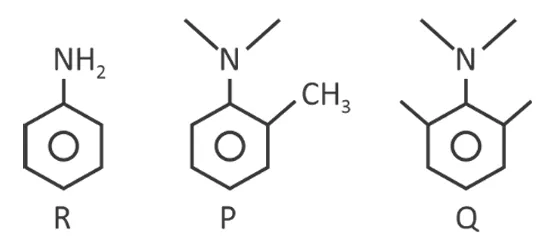
Let's analyze the given compounds shown in the image:
1. Compound R (Aniline):
In aniline, there is no steric hindrance around the amino () group. The lone pair of electrons on the nitrogen atom is fully conjugated with the ring through resonance (+M effect). This strongly activates the ring, especially at the ortho and para positions, leading to the fastest rate of reaction.
2. Compound P (N,N-dimethyl-2-methylaniline):
Here, there is one bulky methyl group () at the ortho position relative to the dimethylamino () group. The steric hindrance between the ortho-methyl group and the methyl groups on nitrogen causes the dimethylamino group to rotate slightly out of the plane of the benzene ring. This reduces the conjugation (+M effect) of the nitrogen lone pair with the ring, thereby decreasing the reaction rate compared to R.
3. Compound Q (N,N-dimethyl-2,6-dimethylaniline):
In this compound, there are two methyl groups flanking the bulky dimethylamino () group at both ortho positions (2 and 6 positions). This creates severe steric crowding, forcing the dimethylamino group to rotate nearly out of the plane of the benzene ring. This phenomenon is known as Steric Inhibition of Resonance (SIR). Because the orbital of the nitrogen lone pair is perpendicular to the ring's pi-system, resonance is completely inhibited. The ring is not activated by the +M effect, making it the least reactive towards electrophilic diazo coupling.
Thus, the rate of reaction follows the order:
Access expert-curated educational resources and study materials—completely free.
Create, conduct, and manage professional online assessments with Mindyard. Perfect for teachers and institutes.
Copyright © 2026 Mindyard. All Rights Reserved.