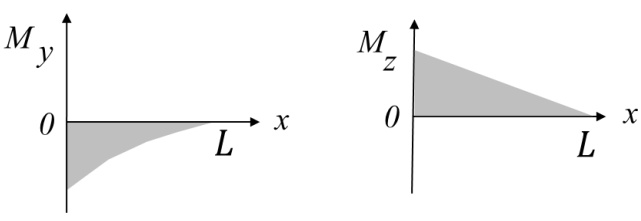
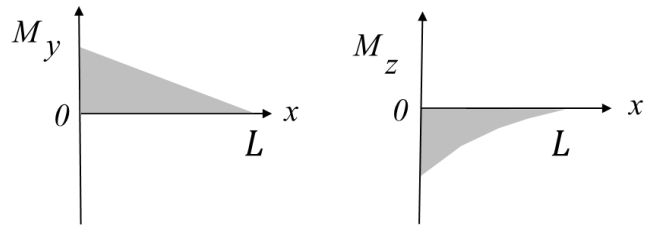
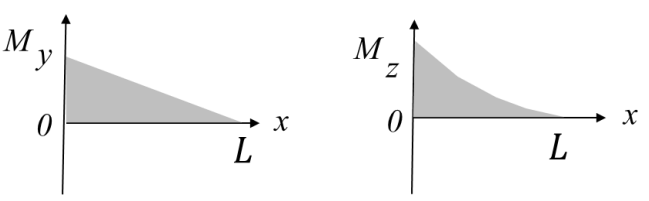
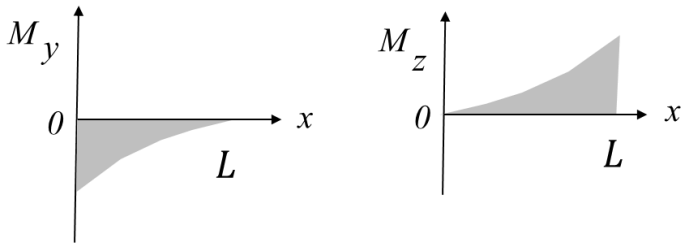
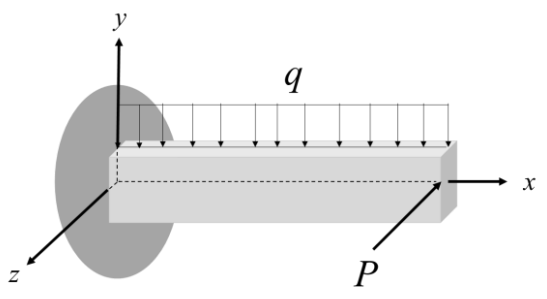
A beam of length 𝐿 is loaded in the 𝑥𝑦 −plane by a uniformly distributed load, and by a concentrated tip load parallel to the 𝑧 −axis, as shown in the figure. The resulting bending moment distributions about the 𝑦 and the 𝑧 axes are denoted by 𝑀𝑦 and 𝑀𝑧 , respectively.
Which one of the options given depicts qualitatively CORRECT variations of 𝑀𝑦 and 𝑀𝑧 along the length of the beam?
Solution :
The correct option depicting the qualitative variations of the bending moments along the length of the beam is the second option:
where
is positive and varies linearly from a maximum value at
to zero at
,
and
is negative and varies quadratically (curved) from a maximum magnitude at
to zero at
.
1. Analysis of Bending Moment about the z-axis ():
The beam is subjected to a uniformly distributed load
acting in the vertical
-plane
downwards (negative
-direction).
Consider a section at a distance
from the fixed support. The length of the segment from this section to the free end is
.
The bending moment about the
-axis at this section is due to the distributed load acting on the segment
:
This equation demonstrates that:
•
is negative (causing hogging, which is standard for downward loading on a cantilever beam).
• The variation is quadratic (parabolic) because of the
term.
• At the support
,
the magnitude is maximum:
.
• At the free end
,
the moment is zero:
.
2. Analysis of Bending Moment about the y-axis ():
The beam is subjected to a concentrated tip load
acting at the free end
parallel to the
-axis in the negative
-direction (pointing into the plane of the page).
The bending moment about the vertical
-axis at a distance
from the fixed support is:
This equation demonstrates that:
•
is positive.
• The variation is linear with respect to
.
• At the support
,
the magnitude is maximum:
.
• At the free end
,
the moment is zero:
.
Comparing these derivations with the options shown in the figures:
•
must be represented by a straight line in the positive region.
•
must be represented by a parabolic curve in the negative region.
This matches the second option.
Completely free for students. Educators & coaching institutes get 2 months free Pro trial to create tests.
Access unlimited practice questions, detailed step-by-step solutions, and exam study materials — completely free for students.
Create and conduct professional online assessments with AI question generation, tab proctoring, and comprehensive batch management.
The GATE 2026 Mechanical Engineering (ME) examination scheduled for 14 February 2026 is one of the most important national-level competitive exams for engineering graduates aspiring for higher education and prestigious career opportunities in PSU and research organizations. Conducted annually at the national level, the GATE Mechanical Engineering paper evaluates candidates on core subjects such as Engineering Mechanics, Thermodynamics, Fluid Mechanics, Strength of Materials, Manufacturing Processes, and Machine Design, along with General Aptitude and Engineering Mathematics. This examination is a gateway for admission into M.Tech/Ph.D. programs at IITs, NITs, IISc, and other top institutions, as well as recruitment in major Public Sector Undertakings (PSUs) like ONGC, NTPC, BHEL, IOCL, and more. The GATE ME 2026 paper will test conceptual understanding, analytical thinking, and problem-solving ability, making strong preparation essential for success. Candidates are advised to practice previous year papers, mock tests, and focus on conceptual clarity for high scoring performance. This exam on 14/02/2026 is a crucial opportunity for mechanical engineering aspirants to secure their future in academia and industry.
Strengthen your preparation with this GATE 2025 Mechanical Engineering (ME) test, covering core subjects such as thermodynamics, fluid mechanics, strength of materials, theory of machines, and manufacturing engineering. With a well-balanced mix of conceptual and numerical questions, this test helps enhance problem-solving ability and technical understanding. Aligned with the latest exam pattern, it is ideal for improving accuracy, speed, and overall exam readiness.
Copyright © 2026 Combe Labs Private Limited. All Rights Reserved.