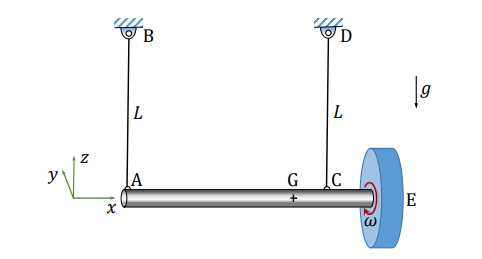
A massive uniform rigid circular disc is mounted on a frictionless bearing at the end E of a massive uniform rigid shaft AE which is suspended horizontally in a uniform gravitational field by two identical light inextensible strings AB and CD as shown, where G is the center of mass of the shaft-disc assembly and 𝑔 is the acceleration due to gravity. The disc is then given a rapid spin 𝜔 about its axis in the positive x-axis direction as shown, while the shaft remains at rest. The direction of rotation is defined by using the right-hand thumb rule. If the string AB is suddenly cut, assuming negligible energy dissipation, the shaft AE will
Solution :
The correct option is: rotate slowly (compared to 𝜔) about the negative z-axis direction
To understand why the shaft AE will rotate slowly about the negative z-axis direction when string AB is cut, we can analyze the system using the principles of gyroscopic precession.
1. Initial State and Coordinate System:
Based on the coordinate system shown in the diagram:
- The x-axis points horizontally to the right along the shaft AE.
- The z-axis points vertically upwards (opposite to the acceleration due to gravity, which acts downwards).
- The y-axis points into the plane of the page to form a right-handed Cartesian coordinate system where:
The disc at end E is spinning rapidly with an angular velocity of 𝜔 in the positive x-axis direction. According to the right-hand rule, the spin angular momentum vector
points in the positive x-direction:
where I is the moment of inertia of the spinning disc.
2. Effect of Cutting String AB:
When string AB is suddenly cut, the shaft is supported only by the string CD at point C.
- The center of mass G of the shaft-disc assembly is located to the left of the support point C (towards point A).
- The position vector of the center of mass G relative to the pivot point C is:
where d is the horizontal distance between C and G.
- The force of gravity acts vertically downwards in the negative z-direction:
where M is the total mass of the assembly and g is the acceleration due to gravity.
3. Torque Calculation:
The torque
about the pivot point C due to gravity is:
Substituting the vector components:
Since
,
the gravitational torque is:
4. Gyroscopic Precession:
By Newton's second law for rotation, the torque is equal to the rate of change of angular momentum:
This equation shows that the change in angular momentum
must point in the negative y-direction. Since the spin angular momentum is initially along the positive x-direction, the addition of a component along the negative y-direction causes the spin vector to rotate towards the negative y-direction (out of the page).
Let
be the precessional angular velocity of the shaft. The rate of change of angular momentum is related to precession by:
Equating this to the torque:
Solving for
:
The negative sign indicates that the precession angular velocity vector points in the negative z-axis direction. Because the disc is spinning rapidly (large 𝜔), the magnitude of the precession angular velocity is very small, meaning the shaft will rotate slowly (compared to 𝜔) about the negative z-axis direction.
Completely free for students. Educators & coaching institutes get 2 months free Pro trial to create tests.
Access unlimited practice questions, detailed step-by-step solutions, and exam study materials — completely free for students.
Create and conduct professional online assessments with AI question generation, tab proctoring, and comprehensive batch management.
The GATE 2026 Mechanical Engineering (ME) examination scheduled for 14 February 2026 is one of the most important national-level competitive exams for engineering graduates aspiring for higher education and prestigious career opportunities in PSU and research organizations. Conducted annually at the national level, the GATE Mechanical Engineering paper evaluates candidates on core subjects such as Engineering Mechanics, Thermodynamics, Fluid Mechanics, Strength of Materials, Manufacturing Processes, and Machine Design, along with General Aptitude and Engineering Mathematics. This examination is a gateway for admission into M.Tech/Ph.D. programs at IITs, NITs, IISc, and other top institutions, as well as recruitment in major Public Sector Undertakings (PSUs) like ONGC, NTPC, BHEL, IOCL, and more. The GATE ME 2026 paper will test conceptual understanding, analytical thinking, and problem-solving ability, making strong preparation essential for success. Candidates are advised to practice previous year papers, mock tests, and focus on conceptual clarity for high scoring performance. This exam on 14/02/2026 is a crucial opportunity for mechanical engineering aspirants to secure their future in academia and industry.
Strengthen your preparation with this GATE 2025 Mechanical Engineering (ME) test, covering core subjects such as thermodynamics, fluid mechanics, strength of materials, theory of machines, and manufacturing engineering. With a well-balanced mix of conceptual and numerical questions, this test helps enhance problem-solving ability and technical understanding. Aligned with the latest exam pattern, it is ideal for improving accuracy, speed, and overall exam readiness.
Copyright © 2026 Combe Labs Private Limited. All Rights Reserved.