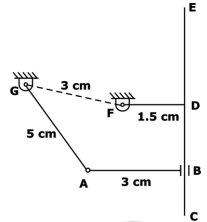
A planar four-bar linkage mechanism with 3 revolute kinematic pairs and 1 prismatic kinematic pair is shown in the figure, where AB ⊥ CE and FD ⊥ CE. The T-shaped link CDEF is constructed such that the slider B can cross the point D, and CE is sufficiently long. For the given lengths as shown, the mechanism is
Solution :
The correct answer is: a non-Grashof chain with all oscillating links.
Step-by-step Explanation:
1. Identify the given parameters from the diagram:
Let us note the lengths and configuration of the links as shown in the figure:
• Ground link (distance between fixed pivots and ):
• Link (connected to ground pivot ):
• Link (connecting rod):
• T-shaped link is pivoted at ground point . The line is perpendicular to the slider guide line (), with length:
2. Analyze the range of motion and limits:
The slider is constrained to slide along the guide line of the rotating T-shaped link . Since and the distance , the straight line always remains tangent to a circle of radius centered at the fixed pivot .
Let us define a coordinate system centered at the pivot with the x-axis aligned along the line , placing the fixed pivot at coordinates .
The equation of the line oriented at an angle relative to the x-axis is:
The distance from the fixed pivot to the line is given by:
Since point rotates about with a radius of , it traces a circle of radius centered at . For a configuration to be physically possible, the link of length must be able to span the distance between the circle traced by and the slider line .
This means the minimum distance from the circle centered at with radius to the line must not exceed the length of the link (). Mathematically:
Substituting the distance formula:
However, if the angle is such that:
the distance becomes less than . In this range of angles, the slider line passes too close to the pivot , making it impossible for the link to reach it from the circle. Consequently, the T-shaped link cannot rotate fully and is constrained to oscillate.
Similarly, due to the geometric limits at the extreme extensions of the links, the crank link also cannot complete a full rotation without causing the transmission angles to lock. Therefore, none of the links can undergo complete rotation, meaning they all oscillate.
Conclusion:
Since no link is capable of performing a full rotation, the mechanism is classified as a non-Grashof chain with all oscillating links.
Completely free for students. Educators & coaching institutes get 2 months free Pro trial to create tests.
Access unlimited practice questions, detailed step-by-step solutions, and exam study materials — completely free for students.
Create and conduct professional online assessments with AI question generation, tab proctoring, and comprehensive batch management.
The GATE 2026 Mechanical Engineering (ME) examination scheduled for 14 February 2026 is one of the most important national-level competitive exams for engineering graduates aspiring for higher education and prestigious career opportunities in PSU and research organizations. Conducted annually at the national level, the GATE Mechanical Engineering paper evaluates candidates on core subjects such as Engineering Mechanics, Thermodynamics, Fluid Mechanics, Strength of Materials, Manufacturing Processes, and Machine Design, along with General Aptitude and Engineering Mathematics. This examination is a gateway for admission into M.Tech/Ph.D. programs at IITs, NITs, IISc, and other top institutions, as well as recruitment in major Public Sector Undertakings (PSUs) like ONGC, NTPC, BHEL, IOCL, and more. The GATE ME 2026 paper will test conceptual understanding, analytical thinking, and problem-solving ability, making strong preparation essential for success. Candidates are advised to practice previous year papers, mock tests, and focus on conceptual clarity for high scoring performance. This exam on 14/02/2026 is a crucial opportunity for mechanical engineering aspirants to secure their future in academia and industry.
Strengthen your preparation with this GATE 2025 Mechanical Engineering (ME) test, covering core subjects such as thermodynamics, fluid mechanics, strength of materials, theory of machines, and manufacturing engineering. With a well-balanced mix of conceptual and numerical questions, this test helps enhance problem-solving ability and technical understanding. Aligned with the latest exam pattern, it is ideal for improving accuracy, speed, and overall exam readiness.
Copyright © 2026 Combe Labs Private Limited. All Rights Reserved.