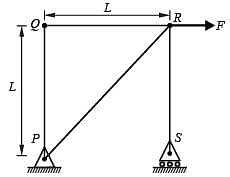
A plane truss PQRS (𝑷𝑸 = 𝑹𝑺, 𝐚𝐧𝐝 ∠𝑷𝑸𝑹 = 𝟗𝟎°) is shown in the figure.
The forces in the members PR and RS, respectively, are _____________
Solution :
Correct Answer: 𐒠√2 (tensile) and 𐒠 (compressive)
Step-by-Step Explanation:
1. Image Analysis & System Setup
Based on the first provided image, we have a plane truss with joints labeled P, Q, R, and S:
- Joint P is a pin support (hinged).
- Joint S is a roller support.
- The length of the vertical member PQ is labeled L, and the length of the horizontal member QR is also L.
- Since PQ = QR = L and the angle ∠PQR is 90°, the angle of the diagonal member PR with the horizontal member QR is:
- A horizontal force F acts at joint R pointing to the right.
2. Identifying Zero-Force Members
Let us analyze joint Q. At joint Q, there are only two non-collinear members PQ and QR, and there is no external load or reaction force acting on this joint.
For joint Q to be in equilibrium:
3. Joint R Equilibrium Analysis
Now, let's analyze joint R. As shown in the second image containing the free-body diagram:
- The horizontal member force FQR is zero.
- The external horizontal force is F acting to the right.
- There is a diagonal member force FPR at an angle of 45° to the horizontal.
- There is a vertical member force FRS acting vertically downwards along the line of member RS.
Assuming both FPR and FRS are tensile forces (pulling away from joint R):
Horizontal Equilibrium (ΣFx = 0):
Since the value is positive, our assumption of tension is correct. Hence, FPR = F√2 (tensile).
Vertical Equilibrium (ΣFy = 0):
Substituting FPR = F√2:
The negative sign indicates that the member force is compressive. Hence, FRS = F (compressive).
Conclusion:
The forces in members PR and RS are F√2 (tensile) and F (compressive) respectively.
Completely free for students. Educators & coaching institutes get 2 months free Pro trial to create tests.
Access unlimited practice questions, detailed step-by-step solutions, and exam study materials — completely free for students.
Create and conduct professional online assessments with AI question generation, tab proctoring, and comprehensive batch management.
The GATE 2026 Mechanical Engineering (ME) examination scheduled for 14 February 2026 is one of the most important national-level competitive exams for engineering graduates aspiring for higher education and prestigious career opportunities in PSU and research organizations. Conducted annually at the national level, the GATE Mechanical Engineering paper evaluates candidates on core subjects such as Engineering Mechanics, Thermodynamics, Fluid Mechanics, Strength of Materials, Manufacturing Processes, and Machine Design, along with General Aptitude and Engineering Mathematics. This examination is a gateway for admission into M.Tech/Ph.D. programs at IITs, NITs, IISc, and other top institutions, as well as recruitment in major Public Sector Undertakings (PSUs) like ONGC, NTPC, BHEL, IOCL, and more. The GATE ME 2026 paper will test conceptual understanding, analytical thinking, and problem-solving ability, making strong preparation essential for success. Candidates are advised to practice previous year papers, mock tests, and focus on conceptual clarity for high scoring performance. This exam on 14/02/2026 is a crucial opportunity for mechanical engineering aspirants to secure their future in academia and industry.
Strengthen your preparation with this GATE 2025 Mechanical Engineering (ME) test, covering core subjects such as thermodynamics, fluid mechanics, strength of materials, theory of machines, and manufacturing engineering. With a well-balanced mix of conceptual and numerical questions, this test helps enhance problem-solving ability and technical understanding. Aligned with the latest exam pattern, it is ideal for improving accuracy, speed, and overall exam readiness.
Copyright © 2026 Combe Labs Private Limited. All Rights Reserved.