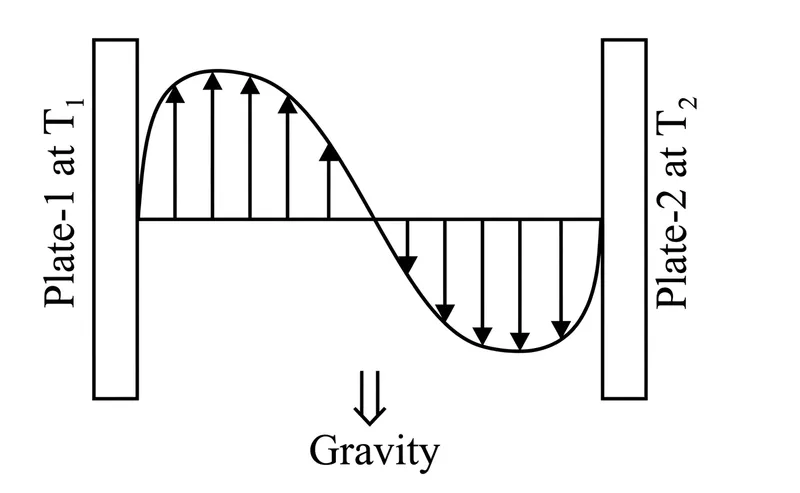
A quiescent fluid at temperature T3 is confined between two vertical parallel plates. While plate 1 is kept at temperature T1 and plate-2 is maintained at temperature T2, A velocity profile between the plates, as shown in the figure below, is generated due to heat transfer. Which one of the following is correct relation between T1, T2 and T3?
Correct Answer :
T1 > T3 and T3 > T2
Solution :
The correct option is: T1 > T3 and T3 > T2.
Let's break down the step-by-step reasoning based on the principles of fluid dynamics and heat transfer:
1. Understanding the Physical System:
Initially, a quiescent (still) fluid is at a uniform temperature of T3.
It is confined between two vertical parallel plates: Plate-1 on the left (at temperature T1) and Plate-2 on the right (at temperature T2).
According to the provided image, gravity acts downwards, as indicated by the downward-pointing double arrow labeled "Gravity".
2. Analyzing the Velocity Profile and Buoyancy Forces:
When a fluid experiences a temperature difference in the presence of a gravity field, density variations occur. This drives natural convection (buoyancy-driven flow):
- Fluid rising (upward flow): Regions of the fluid that are hotter than the bulk fluid (T3) become less dense, causing them to experience an upward buoyant force and rise.
- Fluid sinking (downward flow): Regions of the fluid that are colder than the bulk fluid (T3) become denser, causing them to experience a downward gravitational/buoyant force and sink.
3. Applying this to the Left Plate (Plate-1):
In the image, near the label Plate-1 at T1, the velocity vectors (represented by vertical arrows) point upwards.
This upward motion indicates that the fluid in contact with Plate-1 is warmer than the initial quiescent fluid temperature T3, causing it to expand, lose density, and rise. Therefore, we must have:
4. Applying this to the Right Plate (Plate-2):
Near the label Plate-2 at T2, the velocity vectors point downwards.
This downward motion indicates that the fluid in contact with Plate-2 is cooler than the initial quiescent fluid temperature T3, causing it to contract, gain density, and sink. Therefore, we must have:
Conclusion:
Combining the two temperature relations derived from the buoyancy-driven flow direction shown in the diagram, we get:
This is equivalent to T1 > T3 and T3 > T2.
Access expert-curated educational resources and study materials—completely free.
Create, conduct, and manage professional online assessments with Mindyard. Perfect for teachers and institutes.
Copyright © 2026 Mindyard. All Rights Reserved.