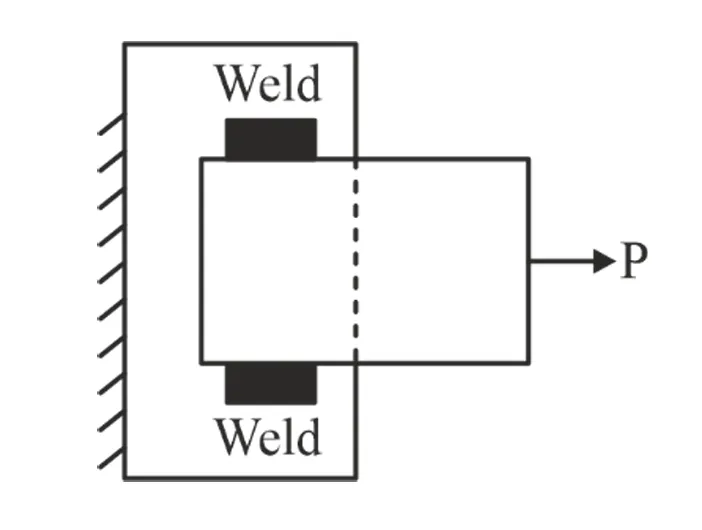
A rectangular plate is perfectly welded to a gusset plate with parallel fillet weld joint as shown in figure. The length of weld is ℓ and fillet weld leg size is h. The allowable shear strength of weldment is τall. A tensile force P is applied on plate in direction parallel to length of weld. Assuming throat of weld as weakest section, the critical load is
Correct Answer :
(hℓτall) / √2
Solution :
The correct answer is:
Step-by-Step Explanation:
1. Visual Analysis of the Image:
As shown in the attached diagram, a rectangular plate is welded to a gusset plate (fixed on the left side, indicated by hatching lines) via fillet welds labeled "Weld" at the top and bottom. A horizontal tensile force vector labeled "P" acts to the right, parallel to the longitudinal direction of the weld runs. The dashed line marks the overlap boundary of the two plates.
2. Geometry of the Fillet Weld Throat:
The weakest section of a fillet weld is its throat section, which is the minimum cross-sectional area along the plane bisecting the weld's right angle. For a fillet weld with a leg size of , the throat thickness is calculated as:
3. Calculating the Shear Area (Throat Area):
The critical area under shear is the throat area of the weld. For a weld length of , the throat area is:
4. Deriving the Critical Load:
The critical load that the weldment can withstand is determined by multiplying its shear area by the allowable shear strength :
Access expert-curated educational resources and study materials—completely free.
Create, conduct, and manage professional online assessments with Mindyard. Perfect for teachers and institutes.
Copyright © 2026 Mindyard. All Rights Reserved.