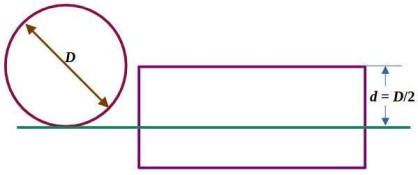
A straight-teeth horizontal slab milling cutter is shown in the figure. It has 4 teeth and diameter (D) of 200 mm. The rotational speed of the cutter is 100 rpm and the linear feed given to the workpiece is 1000 mm/minute. The width of the workpiece (w) is 100 mm, and the entire width is milled in a single pass of the cutter. The cutting force/tooth is given by F = Ktcw, where specific cutting force K = 10 N/mm2, w is the width of cut, and tc is the uncut chip thickness. The depth of cut (d) is D/2, and hence the assumption of is invalid. The maximum cutting force required is ______ KN (round off to one decimal place).
Correct Answer :
Correct answer is : 2.5
Number of teeth z = 4
cutting force/teeth F = Ktcw
specific cutting force K = 10 N/mm2
Depth of cut, d = D/2 hence is invalid
width of cut, w =100 mm
rotational speed N = 100 rpm
diameter of cutter, D = 200 mm
Linear feed to workpiece f = 1000 mm/minute
Maximum uncut chip thickness is
tc, max = f sin θ =
tc, max =
tc, max = = 2.5 mm
Fmax = Kt c, maxw = 10 × 2.5 × 100 = 2500 N = 2.5 kN
Solution :
The correct answer is 2.5.
1. Identified Parameters from the Question and Schematic:
From the given description and the schematic diagram showing the milling cutter of diameter D and the workpiece with a depth of cut d = D/2, we have the following parameters:
• Cutter diameter, D = 200 mm
• Number of teeth, z = 4
• Rotational speed of the cutter, N = 100 rpm
• Linear feed rate of the workpiece, f = 1000 mm/minute
• Workpiece width, w = 100 mm
• Specific cutting force, K = 10 N/mm2
• Depth of cut, d = D/2 = 100 mm
2. Calculating Feed per Tooth:
The feed per tooth, which represents the advance of the workpiece per tooth of the cutter, is calculated as:
Substituting the given values:
3. Determining the Maximum Uncut Chip Thickness:
The uncut chip thickness at any point along the cutting arc is given by:
where is the angle of rotation of the cutter tooth. The maximum uncut chip thickness occurs at the maximum angle of immersion.
Without approximating with the assumption that (which is stated to be invalid because the depth of cut is half the cutter diameter, ), the maximum uncut chip thickness is determined using the exact relation:
Given that , we substitute this relationship into the equation:
Thus, the maximum uncut chip thickness is:
4. Calculating the Maximum Cutting Force:
The cutting force per tooth is given by:
Therefore, the maximum cutting force required is:
Substituting the parameters:
Converting the force from Newtons (N) to kilonewtons (kN):
Access expert-curated educational resources and study materials—completely free.
Create, conduct, and manage professional online assessments with Mindyard. Perfect for teachers and institutes.
Copyright © 2026 Mindyard. All Rights Reserved.