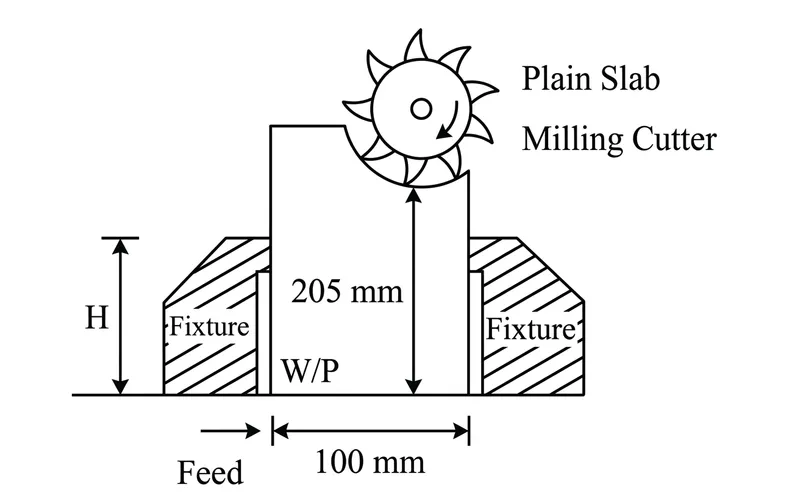
A workpiece is to be firmly hold in fixture. It is to be machine by using a plain slab milling cutting is figure. The most suitable value of height H of the fixture the in mm?
Correct Answer :
150
Solution :
The correct answer is 150.
Step-by-step Explanation:
1. Analysis of the Setup and Parameters from the Image:
Based on the provided diagram, we can observe the following components and dimensions:
- Workpiece (W/P): Has a width of 100 mm at the base.
- Machining Point: The workpiece has a curved profile being machined by a plain slab milling cutter. The distance from the base of the workpiece to the lowest point of the machined profile is 205 mm.
- Fixture: Clamps the workpiece from the sides to firmly hold it against cutting forces. Its height is denoted as H.
- Cutting Action: The slab milling cutter rotates clockwise with the feed direction moving from left to right, representing conventional (up) milling.
2. Constraints on Fixture Height (H):
Collision/Clearance Constraint:
To prevent the slab milling cutter, its arbor, or support collar from colliding with the fixture during the machining stroke, the height of the fixture H must be less than the machining height of the workpiece.
Therefore:
Rigidity and Support Constraint:
The cutting forces in slab milling generate both horizontal and vertical components that create a bending moment tending to tilt or vibrate the workpiece. To ensure stability and prevent deflection during machining, the clamping height should support a significant portion of the workpiece. In fixture design, a common rule of thumb is that the clamping height H should be approximately 70% to 75% of the workpiece height:
3. Evaluation of the Given Options:
- 210 mm: Exceeds the 205 mm machining height. The cutter would crash directly into the fixture, making this value completely unsuitable.
- 200 mm: Too close to 205 mm. A clearance of only 5 mm is insufficient to accommodate the radius of the milling cutter, arbor, and collars, risking collision.
- 70 mm: Too low. Clamping at only 70 mm (about 34% of the workpiece height) does not provide enough rigidity, making the workpiece highly susceptible to tilting and vibration under cutting forces.
- 150 mm: This height is approximately 73% of the workpiece height, providing optimal structural support and clamping stability while leaving a safe clearance of:
This 55 mm gap ensures that the milling cutter and arbor clear the fixture completely during operation. Thus, 150 mm is the most suitable fixture height.
Access expert-curated educational resources and study materials—completely free.
Create, conduct, and manage professional online assessments with Mindyard. Perfect for teachers and institutes.
Copyright © 2026 Mindyard. All Rights Reserved.