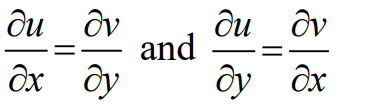
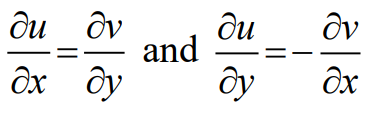
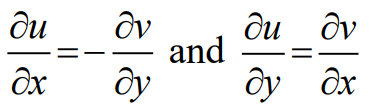
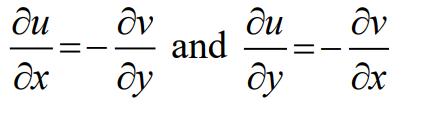
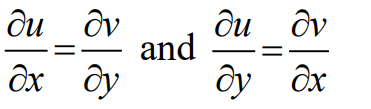
An analytic function f(z) of complex variable z = x + I y may be written as f(z) = u(x, y) + iv (x, y). Then, u(x, y) and v(x, y) must satisfy
Solution :
The correct option/answer is the standard set of Cauchy-Riemann equations, which states that for a complex function to be analytic, its real and imaginary parts must satisfy:
Here is the detailed step-by-step mathematical derivation of these equations based on the definition of analyticity:
Step 1: Definition of the Complex Derivative
For a complex function of the complex variable to be analytic at a point, its derivative must exist and have a unique value regardless of the path along which the limit is taken as :
Step 2: Approaching the Limit along Path 1 (Horizontal Path)
If we approach the point along the real axis (horizontally), the change in the imaginary coordinate is zero, meaning and :
Splitting this limit into real and imaginary components yields:
Step 3: Approaching the Limit along Path 2 (Vertical Path)
If we approach the point along the imaginary axis (vertically), the change in the real coordinate is zero, meaning and :
Since , we can rewrite this expression as:
Step 4: Equating Real and Imaginary Parts
For the derivative to be unique and well-defined, the two limits obtained along Path 1 and Path 2 must be equal:
Equating the real parts on both sides gives:
Equating the imaginary parts on both sides gives:
Completely free for students. Educators & coaching institutes get 2 months free Pro trial to create tests.
Access unlimited practice questions, detailed step-by-step solutions, and exam study materials — completely free for students.
Create and conduct professional online assessments with AI question generation, tab proctoring, and comprehensive batch management.

Prepare for GATE 2026 Civil Engineering with the latest question papers, previous year papers, detailed solutions, syllabus, exam pattern, preparation tips, mock tests, and subject-wise study material. Download GATE 2026 CE question papers with solutions in PDF format and boost your preparation for top engineering institutes and PSU recruitment.

Prepare effectively for GATE 2026 Electronics & Communication Engineering (EC) with this comprehensive Question Paper with Solutions. This resource includes detailed explanations, concept-wise solutions, previous year paper analysis, and exam-oriented practice to help aspirants strengthen core subjects like Electronic Devices, Analog Circuits, Digital Circuits, Signals & Systems, Network Theory, Control Systems, Electromagnetics, Communications, and more. Perfect for revision, self-assessment, and boosting your GATE 2026 EC preparation strategy.
Copyright © 2026 Combe Labs Private Limited. All Rights Reserved.