
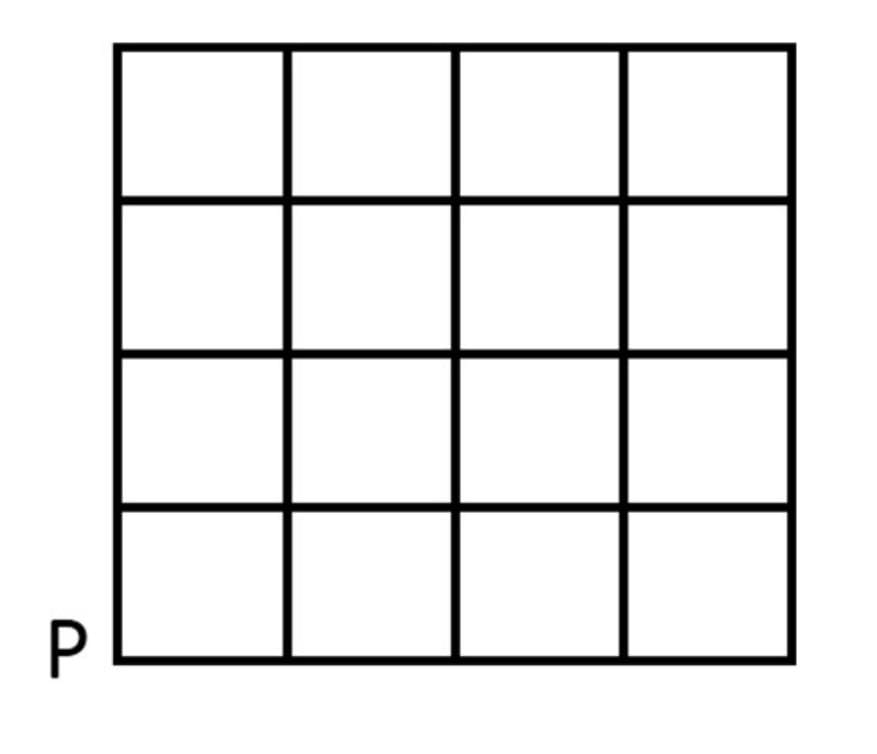
An ant is at the bottom-left corner of a grid (point P) as shown above. It aims to move to the top right corner of the grid. The ant moves only along the lines marked in the grid such that the current distance to the top-right corner strictly decreases. Which one of the following is a part of a possible trajectory of the ant during the movement?
Options
Correct Answer :
Solution :
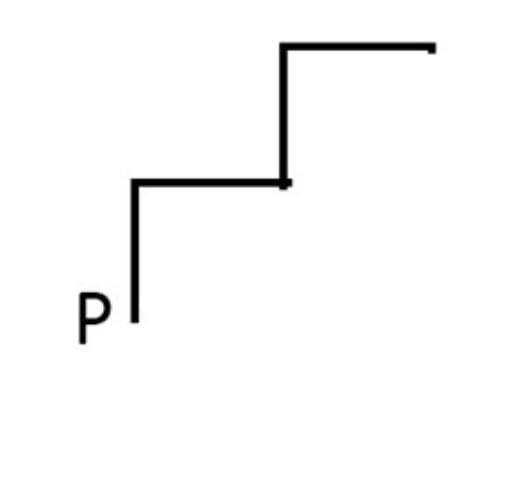
Correct Answer: Option B (corresponding to the staircase trajectory in Image 2)
To determine which option represents a part of a possible trajectory for the ant, we must analyze the rules of movement and the geometry of the grid shown in the images:
1. Grid Layout: As visible in Image 0, the grid is a square grid (4×4 squares, with 5×5 vertices) where the ant starts at the bottom-left corner marked as point P. Let the coordinates of point P be represented as , and the destination at the top-right corner be represented as .
2. Distance Constraint: The ant moves only along the marked grid lines such that the current distance to the destination strictly decreases at every step. The grid distance (Manhattan distance) from any point to the destination is given by the formula:
3. Allowed Directions: For the distance to strictly decrease at every step, the ant must only change its position by increasing or increasing . This means:
• Moving Right (increases by 1, decreasing by 1) is allowed.
• Moving Up (increases by 1, decreasing by 1) is allowed.
• Moving Left (decreases , increasing ) is strictly forbidden.
• Moving Down (decreases , increasing ) is strictly forbidden.
Consequently, any valid trajectory must consist entirely of Up and Right segments without any downward or leftward backtracking.
Now, let's evaluate the options shown in the images:
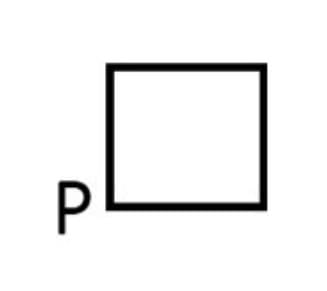
• Option A (Image 1): Shows a closed square loop starting from point P (Up → Right → Down → Left). This trajectory contains downward and leftward segments, which are invalid.
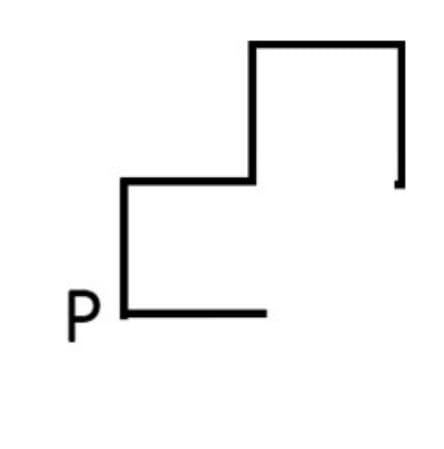
• Option B (Image 2): Shows a staircase path starting from point P that goes Up → Right → Up → Right. Since this path consists solely of Up and Right movements, the distance to the destination strictly decreases at every step. This is a valid part of a possible trajectory.
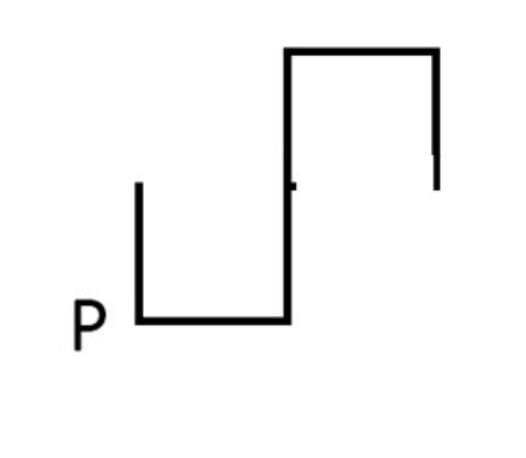
• Option C (Image 3): Shows a path starting from point P that goes Down, then Right, then Up, then Right, then Down. The downward segments increase the distance to the top-right corner, making it invalid.
• Option D (Image 4): Shows a path starting from point P with horizontal and vertical lines that backtrack (containing leftward or downward segments), violating the strictly decreasing distance constraint.
Therefore, only the staircase trajectory shown in Option B (Image 2) is a valid part of the ant's movement.
Access expert-curated educational resources and study materials—completely free.
Create, conduct, and manage professional online assessments with Mindyard. Perfect for teachers and institutes.
Copyright © 2026 Mindyard. All Rights Reserved.