Answer the following question based on the given image:
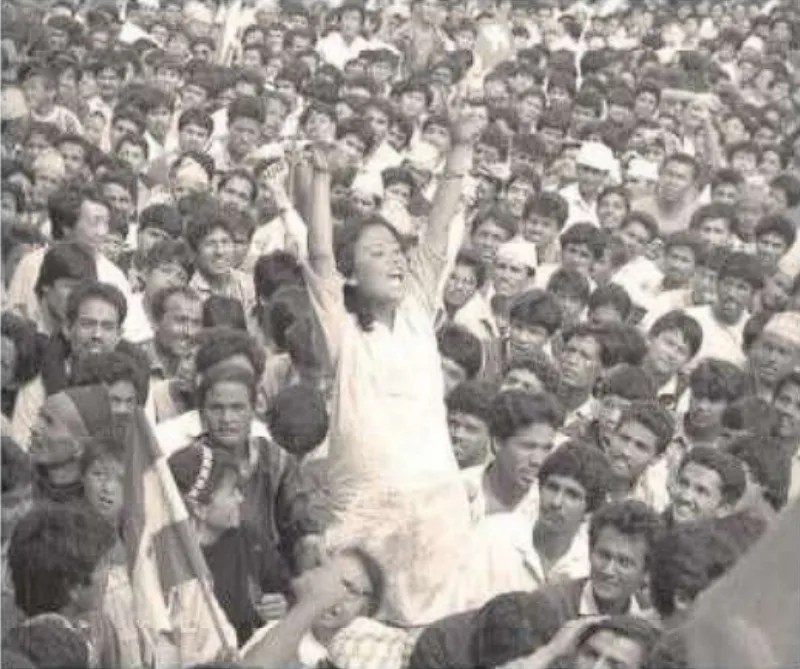
Which among the following statements is not correct about the nature of state and society in Nepal?
Correct Answer :
Nepal was a Buddhist Kingdom in the past
Solution :
The correct option is: Nepal was a Buddhist Kingdom in the past.
Image Analysis:
The provided image depicts a massive crowd of Nepalese citizens participating in a historic pro-democracy protest. In the foreground, on the bottom left, a portion of the distinctive double-triangular flag of Nepal is visible. In the center, a woman is seen raising her arms in a symbol of resistance and victory, illustrating the popular uprising of the people against the monarchy to establish a democratic government.
Detailed Explanation:
To understand why the selected option is correct (i.e., identifying the incorrect statement), we can analyze the history of the state and society in Nepal step-by-step:
1. Nature of the Kingdom (Incorrect Statement):
Historically, Nepal was a Hindu Kingdom, not a Buddhist Kingdom. In fact, it was the only official Hindu state in the world for a long period until the monarchy was abolished. Following the popular democracy movement, Nepal was declared a secular state in 2006 and officially transitioned into a federal democratic republic in 2008. Therefore, the statement "Nepal was a Buddhist Kingdom in the past" is factually incorrect, making it the correct choice for this question.
2. Role of the King and the Army (Correct Statement):
For a long time, the King of Nepal retained absolute control over the administration and government. This control was heavily reinforced by the military (the Royal Nepalese Army), which remained loyal to the crown and was used to suppress democratic uprisings.
3. Influence of the Maoists (Correct Statement):
During the late 1990s and early 2000s, the Maoists (influenced by revolutionary communist ideology) initiated an armed rebellion. They succeeded in spreading their influence deep into the rural and mountainous regions of Nepal, establishing strongholds across large parts of the countryside.
4. Triangular Conflict (Correct Statement):
Nepal's political landscape for over a decade was characterized by a triangular power struggle. The conflict involved:
• The monarchist forces (who wanted to maintain the absolute power of the king),
• The democrats (represented by the mainstream political parties seeking parliamentary democracy), and
• The Maoists (who sought a revolutionary change and the complete elimination of the monarchy).
This triangular conflict eventually resolved when the democrats and Maoists joined forces in a peaceful alliance to overthrow the autocratic rule of the king, leading to the restoration of democracy.
Access expert-curated educational resources and study materials—completely free.
Create, conduct, and manage professional online assessments with Mindyard. Perfect for teachers and institutes.
Copyright © 2026 Mindyard. All Rights Reserved.