Answer the following question based on the given image:
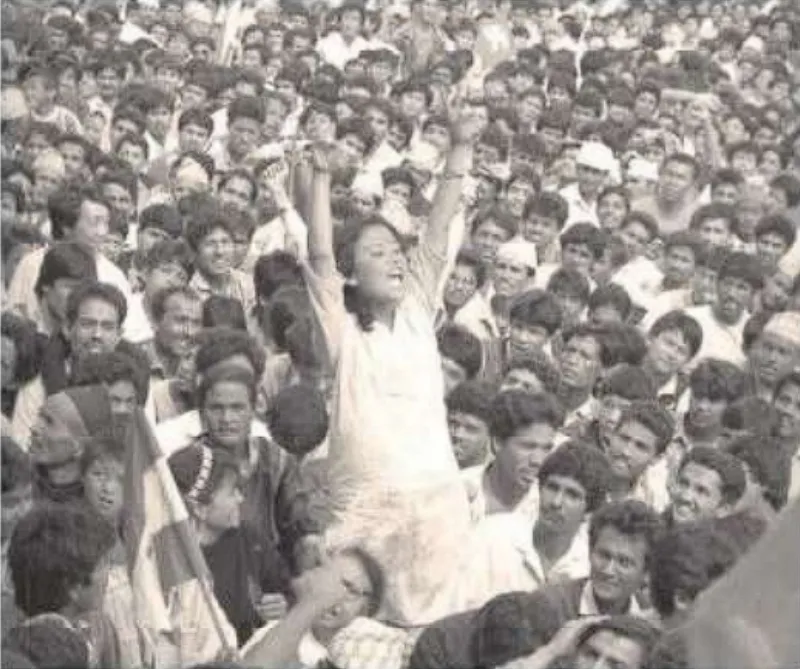
The non-violent movement to restore democracy in Nepal was led by-
Solution :
The correct answer is Seven Party Alliance.
Explanation:
The provided image captures a historic moment of popular protest during the democracy movement in Nepal, showing a dense, expansive crowd of citizens demonstrating. In the center, a woman stands above the crowd with her arms raised in solidarity, symbolizing the collective public resistance, while a flag carried by the demonstrators is visible in the bottom-left corner.
The historical context of this movement is explained below:
1. The Crisis of Democracy: In February 2005, King Gyanendra of Nepal dismissed the prime minister and dissolved the popular government, taking absolute control of the country and suspending fundamental civil rights.
2. Formation of the Alliance: In response to the king's autocratic takeover, all the major political parties of Nepal formed a coalition called the Seven Party Alliance (SPA) to lead a unified struggle to restore democracy.
3. The Popular Struggle: In April 2006, the SPA initiated a non-violent, country-wide movement (known as the second People's Movement or Jana Andolan II). This led to massive daily rallies, strikes, and civil disobedience campaigns joined by millions of ordinary citizens.
4. Successful Outcome: Due to the relentless pressure exerted by the SPA-led non-violent protests, King Gyanendra finally conceded on April 24, 2006, reinstating the parliament and paving the way for the creation of a democratic republic in Nepal.
Completely free for students. Educators & coaching institutes get 2 months free Pro trial to create tests.
Access unlimited practice questions, detailed step-by-step solutions, and exam study materials — completely free for students.
Create and conduct professional online assessments with AI question generation, tab proctoring, and comprehensive batch management.
A comprehensive UPSC Prelims 2015 Paper 1 (General Studies) designed to help aspirants understand the examination pattern and strengthen their preparation for the Civil Services Examination. This paper covers important areas including History, Geography, Indian Polity, Economy, Environment and Ecology, Science and Technology, Current Affairs, and International Relations. It features a balanced mix of conceptual and application-based multiple-choice questions to enhance analytical ability, accuracy, and time management. Based on previous year trends and the UPSC examination pattern, this paper is ideal for practice, revision, self-assessment, concept reinforcement, and final preparation for the UPSC Civil Services Preliminary Examination.
A comprehensive UPSC Prelims 2025 Paper 1 (General Studies) designed to help aspirants understand the latest examination pattern and strengthen their preparation for the Civil Services Examination. This paper covers important areas including History, Geography, Indian Polity, Economy, Environment and Ecology, Science and Technology, Current Affairs, and International Relations. It features a balanced mix of conceptual and application-based multiple-choice questions to enhance analytical ability, accuracy, and time management. Based on previous year trends and the UPSC examination pattern, this paper is ideal for practice, revision, self-assessment, concept reinforcement, and final preparation for the UPSC Civil Services Preliminary Examination.
Copyright © 2026 Combe Labs Private Limited. All Rights Reserved.