
Below are given two sets – Erikson’s Psycho social development (Set-I) and Stage (Set-II). Match the two sets and indicate your answer by selecting the correct code:
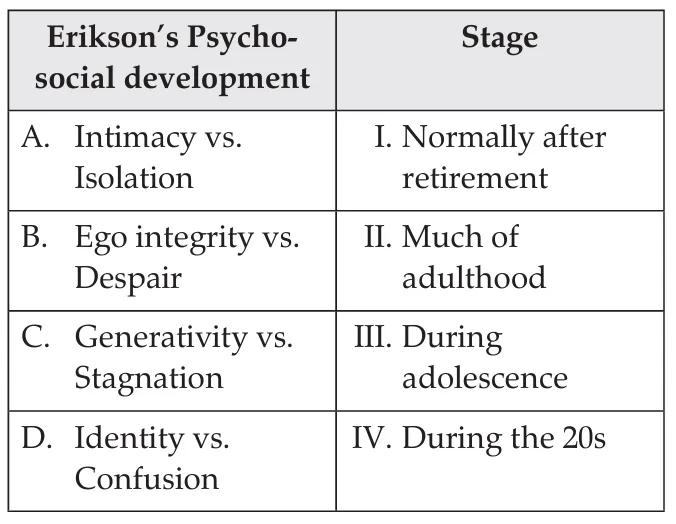
Choose the correct answer from the options given below.
Solution :
The correct option is A - IV, B - I, C - II, D - III.
Based on the table provided in the image, we can match each of Erik Erikson's stages of psychosocial development (Set-I) with its corresponding life stage (Set-II) by understanding the developmental conflicts characteristic of each period of life:
1. A. Intimacy vs. Isolation matches with IV. During the 20s: This stage occurs during young adulthood (typically ages 18 to 40, or during the 20s). The primary conflict centers on forming intimate, loving relationships with other people. Success leads to strong relationships, while failure results in loneliness and isolation.
2. B. Ego integrity vs. Despair matches with I. Normally after retirement: This is the final stage of Erikson's theory, occurring in late adulthood (age 65 and older, which normally corresponds to the post-retirement phase). During this stage, individuals reflect on their lives and either develop a sense of integrity and satisfaction, or experience feelings of despair and regret.
3. C. Generativity vs. Stagnation matches with II. Much of adulthood: Occurring during middle adulthood (typically ages 40 to 65, representing much of adulthood), individuals strive to create or nurture things that will outlast them, often by having children, contributing to positive changes that benefit other people, or being productive at work. Failure to achieve this leads to a sense of stagnation.
4. D. Identity vs. Confusion matches with III. During adolescence: This stage occurs during adolescence (typically ages 12 to 18). Teenagers explore their independence and develop a sense of self and personal identity. Success leads to an ability to stay true to oneself, while failure leads to role confusion and a weak sense of self.
Thus, matching the columns gives us:
- A matches with IV
- B matches with I
- C matches with II
- D matches with III
Completely free for students. Educators & coaching institutes get 2 months free Pro trial to create tests.
Access unlimited practice questions, detailed step-by-step solutions, and exam study materials — completely free for students.
Create and conduct professional online assessments with AI question generation, tab proctoring, and comprehensive batch management.

Prepare effectively with the CTET Paper 2 Set E (20th August 2023) Question Paper with Solutions. This previous year paper includes fully solved questions with detailed explanations to help you understand the latest CTET exam pattern, improve conceptual clarity, and strengthen your preparation for Child Development & Pedagogy, Language I, Language II, Mathematics & Science, or Social Studies/Social Science. Practicing this authentic CTET previous year paper will help you analyze question trends, improve time management, and boost your confidence for upcoming CTET examinations. The official August 2023 Paper 2 Set E question paper is available through the CTET archive.

Prepare for the CTET Paper 2 Set M (31st January 2021) Question Paper with Solutions to strengthen your exam preparation with authentic previous year questions. This solved paper provides detailed explanations for every question, helping you understand the latest CTET syllabus, question pattern, and marking scheme. It covers Child Development & Pedagogy, Language I, Language II, Mathematics & Science, and Social Studies/Social Science, making it an excellent practice resource for aspiring upper primary teachers. Solving this previous year paper will improve your conceptual understanding, accuracy, and time management for the upcoming CTET examination.
Copyright © 2026 Combe Labs Private Limited. All Rights Reserved.


