
Below are given two sets – Scale (Set-I) and Characteristics (Set-II). Match the two sets and indicate your answer by selecting the correct code:
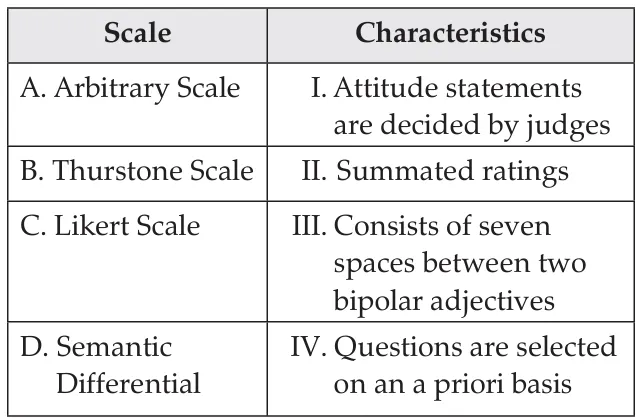
Choose the correct code from the options given below
Correct Answer :
A - IV, B - I, C - II, D - III
Solution :
The correct option is A - IV, B - I, C - II, D - III.
Based on the table provided in the image, we can analyze and match each Scale (Set-I) with its corresponding Characteristics (Set-II) step-by-step:
1. A. Arbitrary Scale matches with IV. Questions are selected on an a priori basis
An arbitrary scale is constructed on a subjective or ad hoc basis. The researcher selects the items or questions that they believe are relevant to the topic on an a priori basis (based on theoretical assumptions or personal judgment prior to empirical testing), without using a systematic scaling procedure.
2. B. Thurstone Scale matches with I. Attitude statements are decided by judges
The Thurstone scaling method (specifically the method of equal-appearing intervals) relies on a panel of independent judges. A large pool of candidate attitude statements is presented to these judges, who sort and rate the intensity of each statement. Their consensus determines the final scale value for each item.
3. C. Likert Scale matches with II. Summated ratings
The Likert scale is the most widely used summated rating scale. Respondents express their level of agreement or disagreement (typically on a 5-point or 7-point scale) for a series of statements. The total score for each respondent is calculated by summing the ratings across all individual items.
4. D. Semantic Differential matches with III. Consists of seven spaces between two bipolar adjectives
The semantic differential scale, developed by Charles E. Osgood, measures the psychological meaning of concepts. It features a set of opposite (bipolar) adjective pairs (such as "Good - Bad" or "Strong - Weak") separated by a multi-point scale, most commonly consisting of seven spaces representing the range of intensity between the opposites.
Combining these matches gives us the correct sequence:
A → IV
B → I
C → II
D → III
Access expert-curated educational resources and study materials—completely free.
Create, conduct, and manage professional online assessments with Mindyard. Perfect for teachers and institutes.
Copyright © 2026 Mindyard. All Rights Reserved.