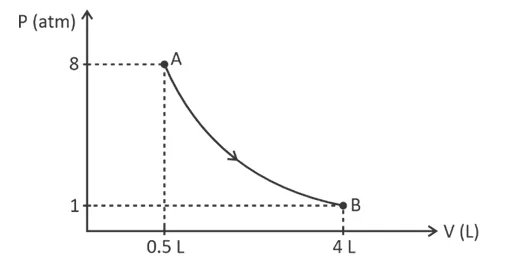
Calculate work in following process during A to B, in following graph. (Given (CV = 3R)
Correct Answer :
–8.3 L.atm
Solution :
To find the work done during the process from state A to state B, we first analyze the parameters given in the P-V diagram:
At state A:
Pressure,
Volume,
At state B:
Pressure,
Volume,
Now, let us check the product of pressure and volume at both states A and B:
At state A:
At state B:
Since the product of pressure and volume remains constant (), this indicates that the temperature of the system is constant throughout the process. Thus, the path from A to B represents a reversible isothermal expansion of an ideal gas.
According to the IUPAC convention in thermodynamics, the work done () during a reversible isothermal expansion is given by:
Since , we can substitute this value into the equation:
Simplify the natural log term:
Using the logarithmic property :
Given that :
Rounding to one decimal place, we obtain:
Access expert-curated educational resources and study materials—completely free.
Create, conduct, and manage professional online assessments with Mindyard. Perfect for teachers and institutes.
Copyright © 2026 Mindyard. All Rights Reserved.