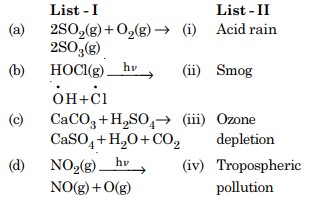
Choose the correct answer from the options given below.
Correct Answer :
(a)-(iv), (b)-(iii), (c)-(i), (d)-(ii)
Solution :
The correct option is (a)-(iv), (b)-(iii), (c)-(i), (d)-(ii).
To determine the correct match between the chemical reactions in List - I and the environmental phenomena in List - II, we can analyze each chemical reaction step-by-step:
1. Reaction (a):
This reaction represents the catalytic oxidation of sulfur dioxide () to sulfur trioxide () in the lower atmosphere. It is a major reaction contributing to air pollution in the troposphere (tropospheric pollution), as sulfur oxides are toxic gases that irritate the respiratory system.
Hence, (a) matches with (iv).
2. Reaction (b):
In the stratosphere, hypochlorous acid () undergoes photolysis in the presence of sunlight () to form chlorine free radicals (). These chlorine radicals catalytically destroy ozone molecules, leading to the depletion of the ozone layer.
Hence, (b) matches with (iii).
3. Reaction (c):
This reaction depicts the corrosion of marble/limestone (calcium carbonate, ) structures and monuments by sulfuric acid () present in acid rain. This causes the stone to deteriorate and turn yellow.
Hence, (c) matches with (i).
4. Reaction (d):
During the daytime, nitrogen dioxide () absorbs sunlight () and decomposes into nitric oxide () and highly reactive nascent oxygen atoms (). These oxygen atoms react with molecular oxygen to produce ozone, which initiates the chain reactions leading to the formation of photochemical smog.
Hence, (d) matches with (ii).
Combining all the individual matches, we get:
(a)-(iv), (b)-(iii), (c)-(i), (d)-(ii)
Access expert-curated educational resources and study materials—completely free.
Create, conduct, and manage professional online assessments with Mindyard. Perfect for teachers and institutes.
Copyright © 2026 Mindyard. All Rights Reserved.