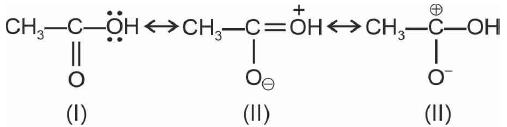
Compare the stability of resonating structures :
Solution :
The correct option is I > II > III.
To determine the relative stability of the resonating structures shown in the image, we apply the following rules of resonance in order of priority:
1. Neutral vs. Charged Structures:
Resonance structures that are neutral (without any charge separation) are more stable than those containing formal positive and negative charges because separating charges requires energy.
In the provided image, Structure (I) () is completely neutral with no formal charges. Therefore, Structure (I) is the most stable structure.
2. Completeness of Octets:
Resonance structures where all atoms have complete valence shell octets are significantly more stable than those with incomplete octets.
Let us evaluate the octets for the charged structures (II) and (III) (labeled as the middle and rightmost structures in the image, respectively):
Combining these points, the overall stability order is:
Completely free for students. Educators & coaching institutes get 2 months free Pro trial to create tests.
Access unlimited practice questions, detailed step-by-step solutions, and exam study materials — completely free for students.
Create and conduct professional online assessments with AI question generation, tab proctoring, and comprehensive batch management.

A comprehensive JEE Advanced 2022 Paper 1 designed to help aspirants understand the examination pattern, difficulty level, and question trends of JEE Advanced. This paper covers important concepts from Physics, Chemistry, and Mathematics, featuring a balanced mix of conceptual, numerical, and advanced application-based questions. It helps students strengthen conceptual understanding, enhance analytical and problem-solving skills, and improve speed and accuracy. Ideal for practice, revision, self-assessment, previous year trend analysis, concept reinforcement, and time management, this paper is a valuable resource for effective JEE Advanced preparation.

A comprehensive JEE Advanced 2022 Paper 2 designed to help aspirants understand the examination pattern, difficulty level, and question trends of JEE Advanced. This paper covers important concepts from Physics, Chemistry, and Mathematics, featuring a balanced mix of conceptual, numerical, and advanced application-based questions. It helps students strengthen conceptual understanding, enhance analytical and problem-solving skills, and improve speed and accuracy. Ideal for practice, revision, self-assessment, previous year trend analysis, concept reinforcement, and time management, this paper is a valuable resource for effective JEE Advanced preparation.
Copyright © 2026 Combe Labs Private Limited. All Rights Reserved.