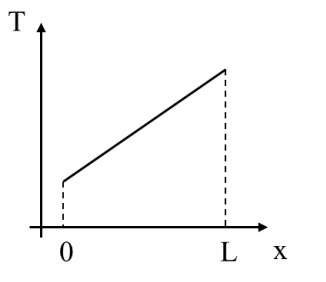
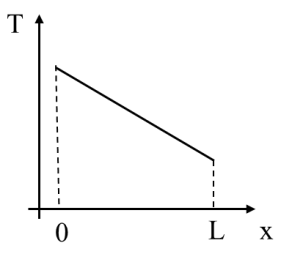
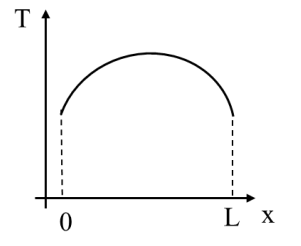
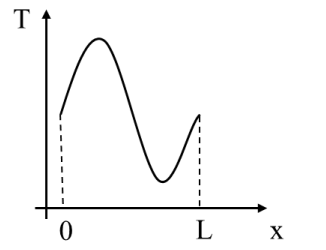
Consider a laterally insulated rod of length L and constant thermal conductivity. Assuming one-dimensional heat conduction in the rod, which of the following steady-state temperature profile(s) can occur without internal heat generation?
Solution :
The correct temperature profile is represented by the straight line with a negative slope, where the temperature decreases linearly from to (corresponding to the option showing a linear profile with a downward slope).
Step-by-Step Mathematical Derivation:
For one-dimensional heat conduction in a rod, the general heat conduction equation is given by Fourier's law and the conservation of energy:
where:
•
is the temperature as a function of position
and time
,
•
is the thermal conductivity of the rod,
•
is the rate of internal heat generation per unit volume,
•
is the density, and
•
is the specific heat capacity.
Simplifying the Governing Equation:
Based on the conditions specified in the problem statement:
1. Constant Thermal Conductivity: Since
is constant, it can be taken outside the spatial derivative.
2. Steady-State Conditions: In steady-state, temperature does not change with time, meaning
.
3. No Internal Heat Generation: There is no heat generated within the rod, so
.
Substituting these conditions simplifies the heat conduction equation to:
Integrating the Simplified Equation:
Integrating once with respect to
yields:
where
is the first constant of integration representing a constant temperature gradient.
Integrating a second time with respect to
yields the temperature profile:
where
is the second constant of integration.
Physical Interpretation of the Profile:
The equation
describes a straight line with a constant slope of
.
• If heat is conducted from left to right along the rod (from
to
), the temperature must decrease in the direction of heat flow according to the second law of thermodynamics (heat flows from high to low temperature). This results in a negative slope (
).
• The correct option shows exactly this case: a straight line starting at a higher temperature at
and decreasing linearly to a lower temperature at
.
• Non-linear temperature profiles (such as parabolic curves or profiles with internal local extrema) require either internal heat generation (which would result in non-zero second-order derivatives) or varying thermal conductivity, neither of which is present here.
Completely free for students. Educators & coaching institutes get 2 months free Pro trial to create tests.
Access unlimited practice questions, detailed step-by-step solutions, and exam study materials — completely free for students.
Create and conduct professional online assessments with AI question generation, tab proctoring, and comprehensive batch management.
The GATE 2026 Mechanical Engineering (ME) examination scheduled for 14 February 2026 is one of the most important national-level competitive exams for engineering graduates aspiring for higher education and prestigious career opportunities in PSU and research organizations. Conducted annually at the national level, the GATE Mechanical Engineering paper evaluates candidates on core subjects such as Engineering Mechanics, Thermodynamics, Fluid Mechanics, Strength of Materials, Manufacturing Processes, and Machine Design, along with General Aptitude and Engineering Mathematics. This examination is a gateway for admission into M.Tech/Ph.D. programs at IITs, NITs, IISc, and other top institutions, as well as recruitment in major Public Sector Undertakings (PSUs) like ONGC, NTPC, BHEL, IOCL, and more. The GATE ME 2026 paper will test conceptual understanding, analytical thinking, and problem-solving ability, making strong preparation essential for success. Candidates are advised to practice previous year papers, mock tests, and focus on conceptual clarity for high scoring performance. This exam on 14/02/2026 is a crucial opportunity for mechanical engineering aspirants to secure their future in academia and industry.
Strengthen your preparation with this GATE 2025 Mechanical Engineering (ME) test, covering core subjects such as thermodynamics, fluid mechanics, strength of materials, theory of machines, and manufacturing engineering. With a well-balanced mix of conceptual and numerical questions, this test helps enhance problem-solving ability and technical understanding. Aligned with the latest exam pattern, it is ideal for improving accuracy, speed, and overall exam readiness.
Copyright © 2026 Combe Labs Private Limited. All Rights Reserved.