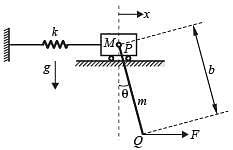
Consider a two degree of freedom system as shown in the figure, where PQ is a rigid uniform rod of length, 𝒃 and mass, 𝒎.
Assume that the spring deflects only horizontally and force F is applied horizontally at Q. For this system, the Lagrangian, L is
Solution :
The correct option is:
Step-by-Step Derivation and Explanation:
1. Understanding the System Coordinates and Parameters
Based on the provided schematic diagram, the system consists of:
• A cart of mass moving horizontally on a frictionless surface. Its horizontal position is given by the coordinate .
• A spring of stiffness attached to the cart, which deflects horizontally by .
• A uniform rigid rod of length and mass pivoted at point on the cart.
• The angle represents the angular displacement of the rod relative to the downward vertical axis.
• The acceleration due to gravity acts vertically downwards.
• A horizontal external force is applied at the free end . Note that non-conservative external forces like do not directly enter the Lagrangian expression; they are treated as generalized forces in the equations of motion. Therefore, the Lagrangian depends solely on the kinetic energy and potential energy of the system.
2. Kinetic Energy of the Cart
Since the cart is constrained to move horizontally with displacement , its velocity is . The kinetic energy of the cart (mass ) is:
3. Kinetic Energy of the Rigid Rod
Consider an infinitesimal mass element on the rod at a distance from the pivot . Since the rod is uniform, the mass density is constant, and we have:
The coordinates of this mass element in a fixed Cartesian coordinate system (where is measured along the rod) are:
Taking time derivatives, we get the velocity components of the mass element:
The square of the velocity of the element is:
Expanding and simplifying using the identity :
Integrating this along the length of the rod to find the total kinetic energy of the rod :
Evaluating the standard integrals:
Simplifying:
Adding the kinetic energy of the cart and the rod together gives the total kinetic energy :
4. Potential Energy of the System
The total potential energy consists of the elastic potential energy stored in the spring and the gravitational potential energy of the rod.
Taking the horizontal line passing through the pivot point as our zero gravitational reference line ():
• Elastic potential energy of the spring:
• Gravitational potential energy of the uniform rod, whose center of mass is located at a distance from the pivot :
Thus, the total potential energy is:
5. Formulating the Lagrangian
The Lagrangian is defined as:
Substituting the derived expressions for and :
Simplifying the signs:
Completely free for students. Educators & coaching institutes get 2 months free Pro trial to create tests.
Access unlimited practice questions, detailed step-by-step solutions, and exam study materials — completely free for students.
Create and conduct professional online assessments with AI question generation, tab proctoring, and comprehensive batch management.

The GATE 2026 Mechanical Engineering (ME) examination scheduled for 14 February 2026 is one of the most important national-level competitive exams for engineering graduates aspiring for higher education and prestigious career opportunities in PSU and research organizations. Conducted annually at the national level, the GATE Mechanical Engineering paper evaluates candidates on core subjects such as Engineering Mechanics, Thermodynamics, Fluid Mechanics, Strength of Materials, Manufacturing Processes, and Machine Design, along with General Aptitude and Engineering Mathematics. This examination is a gateway for admission into M.Tech/Ph.D. programs at IITs, NITs, IISc, and other top institutions, as well as recruitment in major Public Sector Undertakings (PSUs) like ONGC, NTPC, BHEL, IOCL, and more. The GATE ME 2026 paper will test conceptual understanding, analytical thinking, and problem-solving ability, making strong preparation essential for success. Candidates are advised to practice previous year papers, mock tests, and focus on conceptual clarity for high scoring performance. This exam on 14/02/2026 is a crucial opportunity for mechanical engineering aspirants to secure their future in academia and industry.
Strengthen your preparation with this GATE 2025 Mechanical Engineering (ME) test, covering core subjects such as thermodynamics, fluid mechanics, strength of materials, theory of machines, and manufacturing engineering. With a well-balanced mix of conceptual and numerical questions, this test helps enhance problem-solving ability and technical understanding. Aligned with the latest exam pattern, it is ideal for improving accuracy, speed, and overall exam readiness.
Copyright © 2026 Combe Labs Private Limited. All Rights Reserved.