
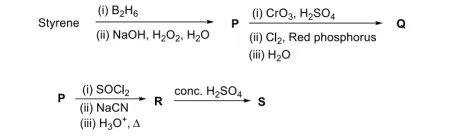
Consider the following reaction scheme and choose the correct option(s) for the major products Q, R, and S.
Options
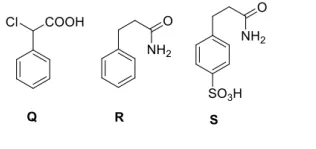
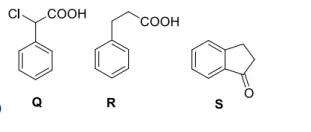
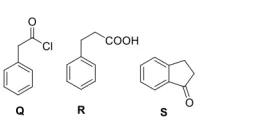
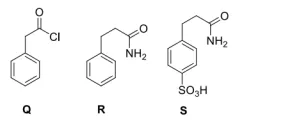
Correct Answer :
Solution :
The correct option showing the major products Q, R, and S is:
Step-by-Step Reaction Mechanism:
1. Formation of Intermediate P (Hydroboration-Oxidation of Styrene):
Styrene, , undergoes hydroboration-oxidation using (i) followed by (ii) . This reaction follows anti-Markovnikov addition of water across the double bond to yield 2-phenylethan-1-ol (or 2-phenylethanol):
2. Formation of Product Q:
Intermediate P () undergoes a sequence of three reactions:
(i) Oxidation with Jones reagent (): Primary alcohol P is oxidized to 2-phenylacetic acid ().
(ii) Hell-Volhard-Zelinsky (HVZ) Reaction (): Chlorination takes place specifically at the -position of the carboxylic acid to form 2-chloro-2-phenylacetyl chloride intermediate.
(iii) Hydrolysis (): The acid chloride group hydrolyzes back to the carboxylic acid, producing 2-chloro-2-phenylacetic acid:
3. Formation of Product R:
Starting again from P ():
(i) Treatment with thionyl chloride (): Replaces the -OH group with a chlorine atom to form (2-chloroethyl)benzene ().
(ii) Nucleophilic substitution with : Cyanide replaces the chloride ion to yield 3-phenylpropanenitrile ().
(iii) Acidic hydrolysis with heating (): Hydrolyzes the nitrile group completely to a carboxylic acid, forming 3-phenylpropanoic acid:
4. Formation of Product S:
Compound R () is treated with concentrated sulfuric acid (). Under these strong acid conditions, intramolecular Friedel-Crafts acylation takes place, where the acylium ion attacks the benzene ring to form a five-membered cyclic ketone ring (1-indanone):
Therefore, the correct major products Q, R, and S match the second option provided in the question image.
Access expert-curated educational resources and study materials—completely free.
Create, conduct, and manage professional online assessments with Mindyard. Perfect for teachers and institutes.
Copyright © 2026 Mindyard. All Rights Reserved.




