Consider the following reaction sequence in which J, K, L and M are the major products.
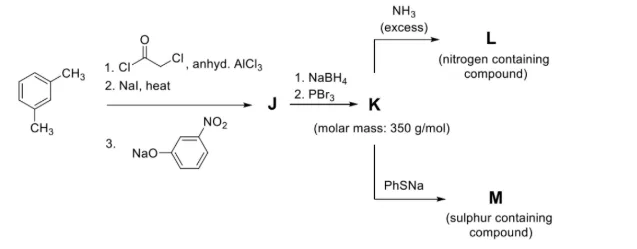
Given:
Atomic mass (in amu): H : 1, C : 12, N : 14, O : 16, S : 32, Br : 80, Ba : 137
In sulphur estimation by Carius method, the amount of BaSO4 formed from 3.79 g of M is _______ g.
Correct Answer :
Solution :
The correct answer is 2.33.
Step 1: Understand the reaction sequence to identify compounds J, K, and M.
Starting reactant: m-xylene (1,3-dimethylbenzene).
1. Formation of J:
- m-Xylene undergoes Friedel-Crafts acylation with chloroacetyl chloride () in the presence of anhydrous . Electro-substitution takes place at the position ortho/para to both methyl groups (position 4 of 1,3-dimethylbenzene), forming 2-chloro-1-(2,4-dimethylphenyl)ethan-1-one.
- Treatment with under heat converts the group into an group via Finkelstein reaction.
- Reaction with sodium 3-nitrophenoxide (
2. Formation of K:
- Reduction of ketone J using yields the corresponding secondary alcohol.
- Treatment with replaces the alcohol group () with a bromine atom (), giving compound K.
- Molecular structure of K: .
- Molar mass of K = , which matches the given molar mass in the image.
3. Formation of M:
- Compound K reacts with sodium thiophenolate () via an SN2 nucleophilic substitution, replacing the atom with a phenylthio group () to give compound M.
- Structure of M: .
Step 2: Calculate the Molar Mass of Compound M
Molecular formula of M =
Using given atomic masses:
Step 3: Carius Method Principle for Sulphur Estimation
In the Carius method, all sulphur present in compound M is quantitatively converted into barium sulphate ().
By Principle of Atom Conservation (POAC) on Sulphur atoms:
Moles of in compound M = Moles of formed
Since 1 mole of compound M contains 1 mole of sulphur ():
Moles of M = Moles of
Step 4: Molar Mass of Barium Sulphate ()
Step 5: Calculate Mass of Formed
Given mass of compound M =
Thus, the amount of formed is 2.33 g.
Access expert-curated educational resources and study materials—completely free.
Create, conduct, and manage professional online assessments with Mindyard. Perfect for teachers and institutes.
Copyright © 2026 Mindyard. All Rights Reserved.