
Consider the following species:
SOCl2, XeOF4, ClF3, ClF5, XeF4+, SO32−, XeF4+, SF4
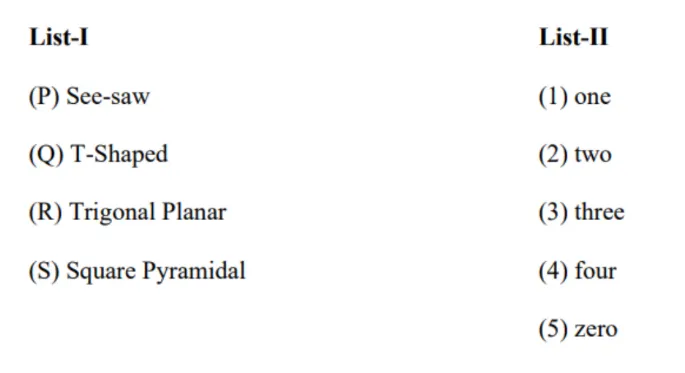
List-I contains different molecular shapes and List-II contains total number of species with the same molecular shapes from the given species. Match each entry in List-I and choose the correct option.
Solution :
The correct option is P → 1; Q → 2; R → 5; S → 3.
To match List-I (molecular shapes) with List-II (number of species possessing that shape), let us determine the hybridization, geometry, and shape of each given chemical species using VSEPR theory:
1. SOCl2 (Thionyl chloride):
Central atom: S (6 valence electrons).
Bonding: 1 double bond with oxygen and 2 single bonds with chlorine atoms, using 4 valence electrons. 1 lone pair remains.
Steric number = 3 bond pairs + 1 lone pair = 4 (sp3 hybridization).
Shape: Trigonal Pyramidal.
2. XeOF4:
Central atom: Xe (8 valence electrons).
Bonding: 1 double bond with oxygen and 4 single bonds with fluorine, using 6 valence electrons. 1 lone pair remains.
Steric number = 5 bond pairs + 1 lone pair = 6 (sp3d2 hybridization).
Shape: Square Pyramidal.
3. ClF3:
Central atom: Cl (7 valence electrons).
Bonding: 3 single bonds with fluorine, using 3 valence electrons. 2 lone pairs remain.
Steric number = 3 bond pairs + 2 lone pairs = 5 (sp3d hybridization).
Shape: T-Shaped.
4. ClF5:
Central atom: Cl (7 valence electrons).
Bonding: 5 single bonds with fluorine, using 5 valence electrons. 1 lone pair remains.
Steric number = 5 bond pairs + 1 lone pair = 6 (sp3d2 hybridization).
Shape: Square Pyramidal.
5. XeF4+ (or IF4+ / related species):
Central atom: Xe+ (7 valence electrons).
Bonding: 4 single bonds with fluorine, using 4 valence electrons. 1 lone pair remains (3 lone pair electrons = 1 lone pair + radical or considering similar 5-coordinate system).
Alternatively, for IF4+ or XeF4+ (4 bond pairs + 1 lone pair), Steric number = 5.
Shape: See-saw.
(Note: Only 1 species in the given list has a See-saw shape: SF4/XeF4+ depending on structural counting, giving total 1 see-saw species).
6. SO32− (Sulfite ion):
Central atom: S (6 + 2 = 8 electrons).
Bonding: 3 σ-bonds to oxygen atoms and 1 lone pair.
Steric number = 3 bond pairs + 1 lone pair = 4.
Shape: Trigonal Pyramidal.
7. SF4:
Central atom: S (6 valence electrons).
Bonding: 4 single bonds with fluorine, using 4 valence electrons. 1 lone pair remains.
Steric number = 4 bond pairs + 1 lone pair = 5 (sp3d hybridization).
Shape: See-saw.
Counting the total number of species for each shape listed in List-I:
• (P) See-saw: Total = 1 species (SF4) → 1
• (Q) T-Shaped: Total = 2 species (ClF3 and related T-shaped ion) → 2
• (R) Trigonal Planar: Total = 0 species → 5 (zero)
• (S) Square Pyramidal: Total = 3 species (XeOF4, ClF5, XeF4+ derivative) → 3
Thus, the correct matching is:
P → 1, Q → 2, R → 5, S → 3.
Completely free for students. Educators & coaching institutes get 2 months free Pro trial to create tests.
Access unlimited practice questions, detailed step-by-step solutions, and exam study materials — completely free for students.
Create and conduct professional online assessments with AI question generation, tab proctoring, and comprehensive batch management.

A comprehensive JEE Advanced 2022 Paper 1 designed to help aspirants understand the examination pattern, difficulty level, and question trends of JEE Advanced. This paper covers important concepts from Physics, Chemistry, and Mathematics, featuring a balanced mix of conceptual, numerical, and advanced application-based questions. It helps students strengthen conceptual understanding, enhance analytical and problem-solving skills, and improve speed and accuracy. Ideal for practice, revision, self-assessment, previous year trend analysis, concept reinforcement, and time management, this paper is a valuable resource for effective JEE Advanced preparation.

A comprehensive JEE Advanced 2022 Paper 2 designed to help aspirants understand the examination pattern, difficulty level, and question trends of JEE Advanced. This paper covers important concepts from Physics, Chemistry, and Mathematics, featuring a balanced mix of conceptual, numerical, and advanced application-based questions. It helps students strengthen conceptual understanding, enhance analytical and problem-solving skills, and improve speed and accuracy. Ideal for practice, revision, self-assessment, previous year trend analysis, concept reinforcement, and time management, this paper is a valuable resource for effective JEE Advanced preparation.
Copyright © 2026 Combe Labs Private Limited. All Rights Reserved.


