Consider the strong electrolytes ZmXn, UmYp and VmXn. Limiting molar conductivity (Λ°) of UmYp and VmXn are 250 and 440 S cm2 mol−1, respectively. The value of (m + n + p) is_______.
Given:
| Ion | Zn+ | Up+ | Vn+ | Xm− | Ym− |
|---|---|---|---|---|---|
| λ° (S cm2 mol−1) | 50.0 | 25.0 | 100.0 | 80.0 | 100.0 |
λ° is the limiting molar conductivity of ions
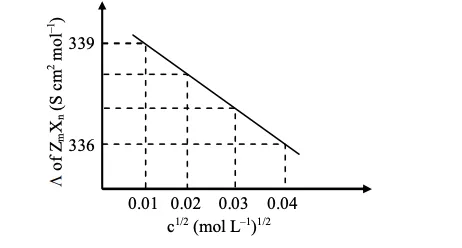
The plot of molar conductivity (Λm) of ZmXn vs c1/2 is given below:
Correct Answer :
Solution :
The correct answer is 7.
Step 1: Understanding Kohlrausch's Law of Independent Migration of Ions
According to Kohlrausch's law, the limiting molar conductivity of an electrolyte is equal to the sum of the limiting molar conductivities of its constituent cations and anions, each multiplied by the number of ions present per formula unit.
For an electrolyte AxBy containing x cations of charge +y and y anions of charge -x:
Step 2: Set up equations using the given data for UmYp and VmXn
From the given table, the ionic limiting molar conductivities (in S cm2 mol−1) are:
• λ°(Zn+) = 50.0
• λ°(Up+) = 25.0
• λ°(Vn+) = 100.0
• λ°(Xm−) = 80.0
• λ°(Ym−) = 100.0
1. For the electrolyte UmYp:
The formula unit contains m Up+ ions and p Ym− ions.
Given Λ°(UmYp) = 250 S cm2 mol−1:
Dividing the entire equation by 25 gives:
--- (Equation 1)
2. For the electrolyte VmXn:
The formula unit contains m Vn+ ions and n Xm− ions.
Given Λ°(VmXn) = 440 S cm2 mol−1:
Dividing the entire equation by 20 gives:
--- (Equation 2)
Step 3: Determine the value of m from the plot of ZmXn
The graph shows a linear plot of molar conductivity (Λm) of ZmXn vs c1/2:
From the plot, we can read two distinct coordinates (c1/2, Λm):
• At c1/2 = 0.01 (mol L−1)1/2, Λm = 339 S cm2 mol−1
• At c1/2 = 0.04 (mol L−1)1/2, Λm = 336 S cm2 mol−1
According to Debye-Hückel-Onsager equation for a strong electrolyte:
We can find the limiting molar conductivity by finding the y-intercept (extrapolating to c1/2 = 0):
Now using the point (0.01, 339):
Now apply Kohlrausch's law for ZmXn:
Dividing by 10 gives:
--- (Equation 3)
Step 4: Solve for m, n, and p
Subtract Equation 2 from Equation 3:
Substitute n = 3 into Equation 2:
Substitute m = 2 into Equation 1:
Step 5: Calculate the value of (m + n + p)
Thus, the value of (m + n + p) is 7.
Access expert-curated educational resources and study materials—completely free.
Create, conduct, and manage professional online assessments with Mindyard. Perfect for teachers and institutes.
Copyright © 2026 Mindyard. All Rights Reserved.