
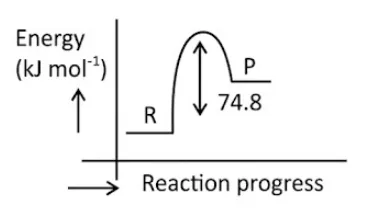
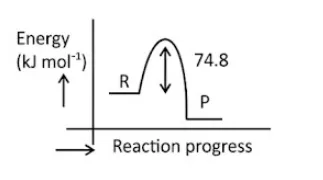
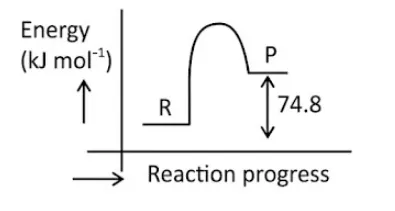
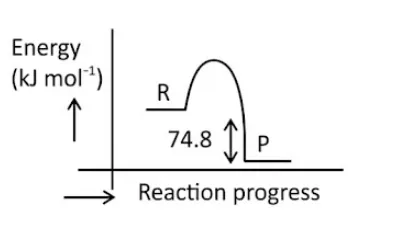
C(s) + 2H2(g) → CH4(g); ΔH = –74.8 kJ mol–1. Which of the following diagrams gives an accurate representation of the above reaction? [R → reactants; P → products]
Options
Solution :
To determine which diagram accurately represents the given chemical reaction, let us analyze the reaction equation and its enthalpy change:
;
1. Endothermic vs. Exothermic Reaction:
The change in enthalpy () for the reaction is negative (). This indicates that the reaction is exothermic, meaning heat is released to the surroundings.
For an exothermic reaction, the total enthalpy of the products (P) is less than the total enthalpy of the reactants (R):
Therefore, on the energy diagram, the energy level of the products (P) must lie lower than the energy level of the reactants (R).
2. Meaning of Enthalpy Change ():
The enthalpy change represents the difference in energy between the reactants and the products:
The vertical distance between the reactant energy level (R) and the product energy level (P) must be equal to .
3. Evaluating the Diagrams:
- Option 1 (image_0.webp): Shows an endothermic reaction profile (P is higher than R), and the arrow showing goes from the reactants to the transition state (activation energy). This is incorrect.
- Option 2 (image_1.webp): Shows an exothermic reaction profile (P is lower than R), but the arrow showing represents the activation energy (reactants to transition state peak) rather than . This is incorrect.
- Option 3 (image_2.webp): Shows an endothermic reaction profile (P is higher than R), where the difference between R and P is . This represents a reaction with . This is incorrect.
- Option 4 (image_3.webp): Shows an exothermic reaction profile (P is lower than R), and the vertical double-headed arrow showing correctly represents the energy difference between the reactants (R) and products (P). This is correct.
Thus, the fourth diagram (Option 4) is the correct representation.
Completely free for students. Educators & coaching institutes get 2 months free Pro trial to create tests.
Access unlimited practice questions, detailed step-by-step solutions, and exam study materials — completely free for students.
Create and conduct professional online assessments with AI question generation, tab proctoring, and comprehensive batch management.

A comprehensive JEE Advanced 2022 Paper 1 designed to help aspirants understand the examination pattern, difficulty level, and question trends of JEE Advanced. This paper covers important concepts from Physics, Chemistry, and Mathematics, featuring a balanced mix of conceptual, numerical, and advanced application-based questions. It helps students strengthen conceptual understanding, enhance analytical and problem-solving skills, and improve speed and accuracy. Ideal for practice, revision, self-assessment, previous year trend analysis, concept reinforcement, and time management, this paper is a valuable resource for effective JEE Advanced preparation.

A comprehensive JEE Advanced 2022 Paper 2 designed to help aspirants understand the examination pattern, difficulty level, and question trends of JEE Advanced. This paper covers important concepts from Physics, Chemistry, and Mathematics, featuring a balanced mix of conceptual, numerical, and advanced application-based questions. It helps students strengthen conceptual understanding, enhance analytical and problem-solving skills, and improve speed and accuracy. Ideal for practice, revision, self-assessment, previous year trend analysis, concept reinforcement, and time management, this paper is a valuable resource for effective JEE Advanced preparation.
Copyright © 2026 Combe Labs Private Limited. All Rights Reserved.


