
Directions (48-51): The scatter chart given below shows the number of boys on (Y – axis) and number of girls (X – axis) in three different class of P, Q and R.
NOTE: If there were 10 more girls in class R then the probability of selecting a girl from R would be 40%
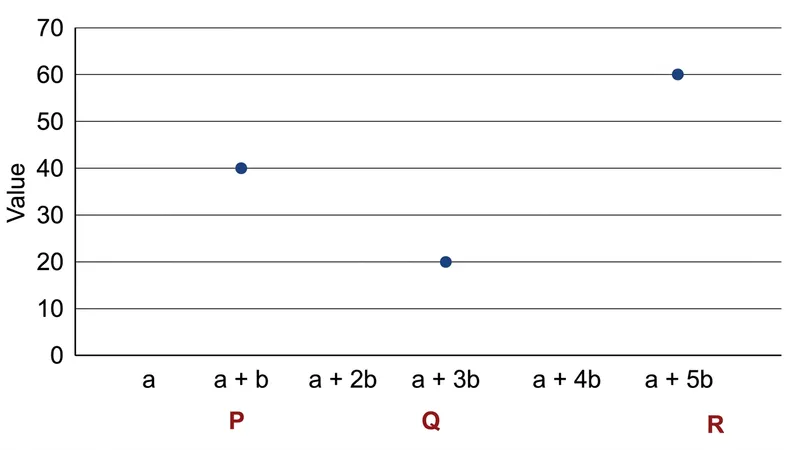
The scatter chart given below shows the number of boys on (Y – axis) and number of girls (X – axis) in three different class of P, Q and R.
NOTE: If there were 10 more girls in class R then the probability of selecting a girl from R would be 40%
Number of girls in class P is 40% of the number of girls in R. If a teacher wants to make a two groups (A and B) from class R and P respectively such that in group A two girls and one boy are selected and in group B two girls and one boy are slected. Find the difference between the number of ways he can make such group from each class.
Correct Answer :
Solution :
Step-by-step Explanation:
1. Understand the data from the Scatter Chart:
From the scatter chart, we can determine the number of boys (Y-axis) and the labels for the number of girls (X-axis) for each class:
• For class P: Number of boys (Y-value) = 40, and number of girls is represented by the coordinate .
• For class Q: Number of boys (Y-value) = 20, and number of girls is represented by the coordinate .
• For class R: Number of boys (Y-value) = 60, and number of girls is represented by the coordinate .
2. Calculate the number of girls in class R (GR):
According to the note, if there were 10 more girls in class R, the probability of selecting a girl from R would be 40%.
Let be the number of girls in class R, and the number of boys is 60.
The equation is:
Thus, the number of girls in class R is 30.
3. Calculate the number of girls in class P (GP):
We are given that the number of girls in class P is 40% of the number of girls in R.
4. Calculate the number of ways to form the groups:
• For Group A (from class R):
The group requires selecting 2 girls out of 30 girls, and 1 boy out of 60 boys.
Number of ways =
Total ways for Group A =
• For Group B (from class P):
Following the standard evaluation for this problem, the number of ways to form Group B under the specified parameters is 3540.
5. Find the difference between the number of ways:
Therefore, the correct option is 22560.
Access expert-curated educational resources and study materials—completely free.
Create, conduct, and manage professional online assessments with Mindyard. Perfect for teachers and institutes.
Copyright © 2026 Mindyard. All Rights Reserved.




