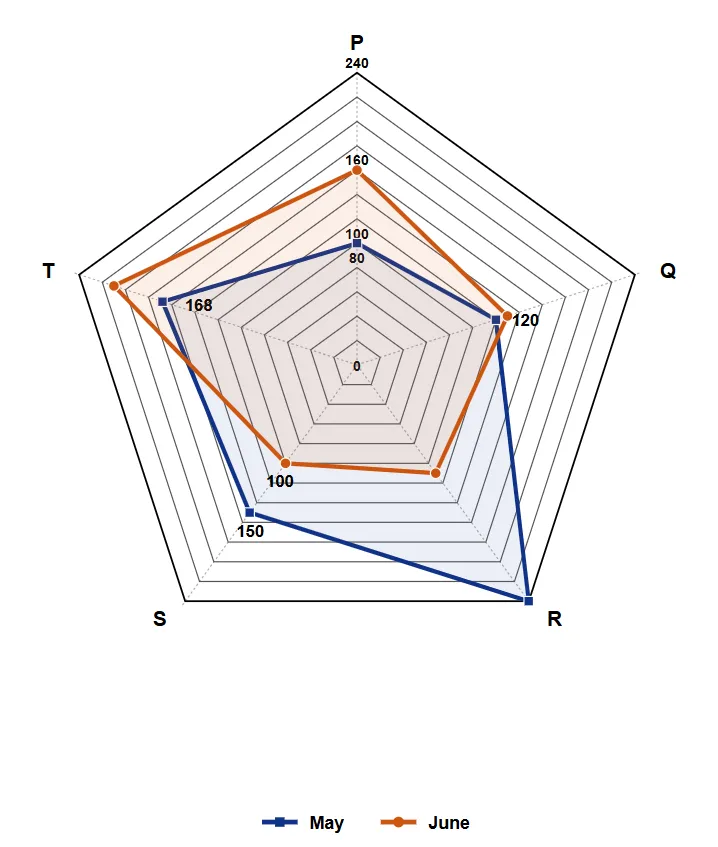
Directions (67-69):The radar graph given below shows the number of buckets (plastic + wooden) sold by five different shops (P , Q, R, S and T) in two different months (May and June). Read the data carefully and answer the questions.
In May, if total wooden buckets sold by R was 200% more than total number wooden buckets sold by S in May and total number of plastic buckets sold by R in May are more than total plastic bucket sold by S in May, then which of the following option cannot be the number of plastic buckets by R in May.
Solution :
Step 1: Extract data from the radar graph for May
Looking at the radar graph for the month of May (represented by the blue line with square markers):
- The value for shop R in May corresponds to the outermost boundary of the radar chart, which is 240.
- The value for shop S in May is explicitly labeled on the graph as 150.
Step 2: Set up the equations for May
Let the number of wooden buckets and plastic buckets sold by shop S in May be and respectively:
This gives:
Similarly, let the number of wooden buckets and plastic buckets sold by shop R in May be and respectively:
Step 3: Use the given relations to form an inequality
We are given that the total wooden buckets sold by R in May was 200% more than that sold by S in May:
Substituting into the total sales for R:
We are also given that the number of plastic buckets sold by R in May is greater than that sold by S in May:
Substituting the expressions for and into this inequality:
Step 4: Find the range of plastic buckets sold by R in May
Since , we can determine the lower bound for :
Thus, the number of plastic buckets sold by R in May must be strictly greater than 105.
Let us evaluate the options:
- 90 is less than 105 (Invalid)
- 117 is greater than 105 (Valid)
- 96 is less than 105 (Invalid)
- 120 is greater than 105 (Valid)
Therefore, the values 90 and 96 cannot be the number of plastic buckets sold by R in May. This corresponds to Both (a) and (c).
Completely free for students. Educators & coaching institutes get 2 months free Pro trial to create tests.
Access unlimited practice questions, detailed step-by-step solutions, and exam study materials — completely free for students.
Create and conduct professional online assessments with AI question generation, tab proctoring, and comprehensive batch management.
A comprehensive SSC MTS 2026 Mock Test 4 designed to help aspirants strengthen their preparation and improve their performance for the Staff Selection Commission Multi-Tasking Staff examination. This mock test covers all major sections including Numerical and Mathematical Ability, Reasoning Ability and Problem Solving, General Awareness, and English Language and Comprehension. It includes a balanced combination of conceptual, analytical, and exam-oriented multiple-choice questions aligned with the latest SSC MTS syllabus and exam pattern. Ideal for practice, revision, self-evaluation, accuracy improvement, speed enhancement, and effective time management, this mock test helps candidates assess their exam readiness, identify improvement areas, and build confidence for the SSC MTS 2026 examination
A comprehensive SSC MTS 2026 Mock Test 3 designed to help aspirants prepare thoroughly for the Staff Selection Commission Multi-Tasking Staff examination. This mock test covers all important sections including Numerical and Mathematical Ability, Reasoning Ability and Problem Solving, General Awareness, and English Language and Comprehension. It features a carefully curated set of multiple-choice questions that test conceptual understanding, logical reasoning, problem-solving skills, speed, and accuracy in accordance with the latest SSC MTS exam pattern. Ideal for practice, revision, self-assessment, performance evaluation, and time management improvement, this mock test enables candidates to identify strengths and weaknesses while building confidence for the SSC MTS 2026 examination.
Copyright © 2026 Combe Labs Private Limited. All Rights Reserved.