
For a reaction A→B, enthalpy of reaction is −4.2 kJ mol−1 and enthalpy of activation is 9.6 kJ mol−1. The correct potential energy profile for the reaction is shown in option.
Options
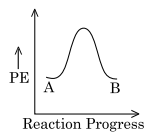
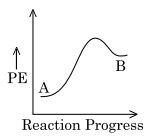
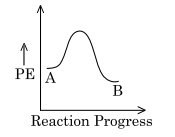
Correct Answer :
Solution :
The correct potential energy profile for the reaction is given by the graph shown in:
Step-by-step Explanation:
1. Understand the given data:
- Enthalpy of reaction () =
- Enthalpy (or activation energy) of activation () =
2. Analyze the Enthalpy of Reaction ():
The enthalpy of a reaction is related to the potential energies of the reactant (A) and product (B) by the relation:
Since , the reaction is exothermic.
For an exothermic reaction:
This means that the potential energy level of the products (B) on the vertical axis (PE) must be lower than the potential energy level of the reactants (A).
3. Analyze the Activation Energy ():
Activation energy is always a positive quantity (). This represents the energy barrier that reactants must overcome to form products. Thus, the curve must first rise from the reactant level A to a peak (transition state) and then fall down to the product level B.
4. Conclusion:
In the potential energy vs. reaction progress diagram, the curve goes up to a maximum (activation barrier) and then drops down such that the final energy level of B is lower than the initial energy level of A. Therefore, the diagram representing an exothermic reaction profile with product B at a lower potential energy than reactant A is the correct graph shown above.
Access expert-curated educational resources and study materials—completely free.
Create, conduct, and manage professional online assessments with Mindyard. Perfect for teachers and institutes.
Copyright © 2026 Mindyard. All Rights Reserved.




