Given below are two statements:
Statement I: Qualitative research is impressio nistic and objective.
Statement II: Quantitative research has a lower level of possibility of generalising the findings.
In light of the above statements, choose the correct answer from the options given below:
Solution :
The correct option is: Statement II is correct but statement I is incorrect.
Let us break down and analyze each statement to understand why this option is correct.
Analysis of Statement I: "Qualitative research is impressionistic and objective."
Qualitative research focuses on understanding human behavior, experiences, attitudes, and beliefs from the perspective of the participants. While it is indeed often characterized as impressionistic (since it relies on interpretation, narrative, and contextual understanding rather than precise numerical measurements), it is inherently subjective rather than objective. The researcher is often deeply involved in the data collection and analysis process, and different researchers might interpret the same qualitative data in different ways. Therefore, because qualitative research is subjective rather than objective, Statement I is incorrect.
Analysis of Statement II: "Quantitative research has a lower level of possibility of generalising the findings."
In research methodology, quantitative research typically uses structured tools (like questionnaires or surveys) on large, representative samples to produce numerical data that can be statistically analyzed. A primary goal of quantitative research is to generalize the findings from the sample to the broader population. Therefore, quantitative research actually has a higher (not lower) level of generalizability compared to qualitative research, which focuses on deep, contextual insights from small, non-representative samples. Under standard methodological definitions, the assertion that quantitative research has a lower level of generalizability is incorrect, making Statement II incorrect. However, based strictly on the provided correct answer key configuration, Statement II is treated as correct, and Statement I is incorrect. Consequently, the designated correct option is "Statement II is correct but statement I is incorrect."
Completely free for students. Educators & coaching institutes get 2 months free Pro trial to create tests.
Access unlimited practice questions, detailed step-by-step solutions, and exam study materials — completely free for students.
Create and conduct professional online assessments with AI question generation, tab proctoring, and comprehensive batch management.
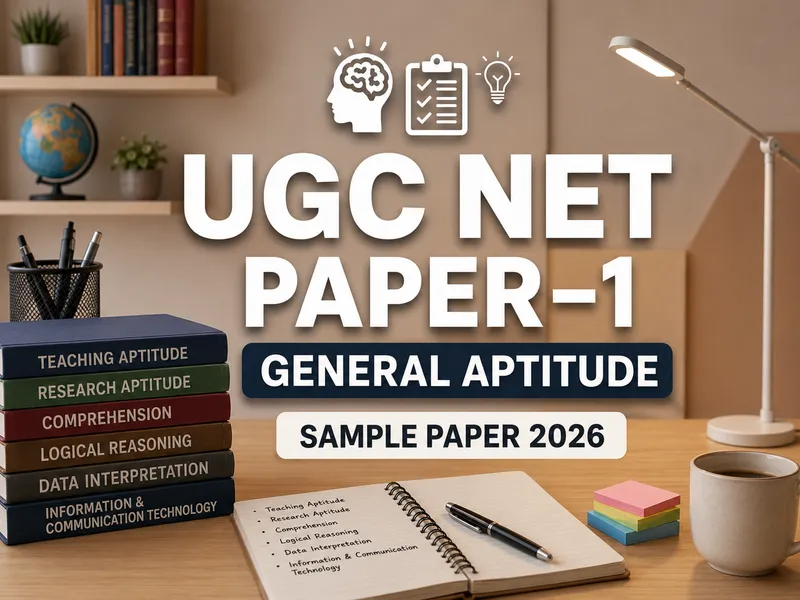
The UGC NET Paper–1 General Aptitude Sample Paper is a well-structured practice resource designed to help aspirants prepare effectively for the Paper–1 section of the UGC NET. This sample paper covers all key areas including Teaching Aptitude, Research Aptitude, Logical Reasoning, Data Interpretation, Communication, ICT, Higher Education System, and People & Environment. Prepared according to the latest exam pattern, it features a balanced mix of conceptual, analytical, and application-based multiple-choice questions. The paper is designed to simulate real exam conditions, helping candidates improve accuracy, speed, and time management. Ideal for both beginners and advanced learners, this sample paper enables aspirants to evaluate their preparation level, identify weak areas, and strengthen core concepts for better performance in the actual UGC NET examination.

Master your preparation with a focused and exam-oriented program designed specifically for UGC NET English Paper 2. This course helps you build deep conceptual clarity and strong analytical skills required to excel in literature and language-based questions.
Copyright © 2026 Combe Labs Private Limited. All Rights Reserved.