
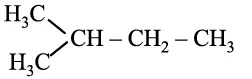
How many products (including stereoisomers) are expected from monochlorination of the following compound?
Solution :
The correct option is 6.
The given compound shown in the image is isopentane (also known as 2-methylbutane):
To determine the total number of monochlorination products (including stereoisomers), we identify the different types of hydrogen atoms available for substitution in 2-methylbutane:
1. Substitution at the C-1 methyl groups (the two equivalent groups on C-2):
Substituting a hydrogen atom on either of these methyl groups yields:
(1-chloro-2-methylbutane)
In this product, the C-2 carbon atom becomes a chiral center (marked with an asterisk *). Therefore, this compound exists as a pair of enantiomers:
• -1-chloro-2-methylbutane
• -1-chloro-2-methylbutane
This contributes 2 stereoisomers.
2. Substitution at the C-2 position ( group):
Substituting the hydrogen atom at the C-2 position yields:
(2-chloro-2-methylbutane)
This molecule does not possess any chiral center and is achiral.
This contributes 1 product.
3. Substitution at the C-3 position ( group):
Substituting a hydrogen atom at the C-3 position yields:
(2-chloro-3-methylbutane)
In this product, the C-3 carbon atom becomes a chiral center (marked with an asterisk *). Therefore, this compound exists as a pair of enantiomers:
• -2-chloro-3-methylbutane
• -2-chloro-3-methylbutane
This contributes 2 stereoisomers.
4. Substitution at the C-4 methyl group ( group at the end of the chain):
Substituting a hydrogen atom at the C-4 position yields:
(1-chloro-3-methylbutane)
This molecule does not possess any chiral center and is achiral.
This contributes 1 product.
Total Number of Products:
Adding up the products from all positions:
Thus, a total of 6 monochlorinated products (including stereoisomers) are expected.
Completely free for students. Educators & coaching institutes get 2 months free Pro trial to create tests.
Access unlimited practice questions, detailed step-by-step solutions, and exam study materials — completely free for students.
Create and conduct professional online assessments with AI question generation, tab proctoring, and comprehensive batch management.

A comprehensive JEE Advanced 2022 Paper 1 designed to help aspirants understand the examination pattern, difficulty level, and question trends of JEE Advanced. This paper covers important concepts from Physics, Chemistry, and Mathematics, featuring a balanced mix of conceptual, numerical, and advanced application-based questions. It helps students strengthen conceptual understanding, enhance analytical and problem-solving skills, and improve speed and accuracy. Ideal for practice, revision, self-assessment, previous year trend analysis, concept reinforcement, and time management, this paper is a valuable resource for effective JEE Advanced preparation.

A comprehensive JEE Advanced 2022 Paper 2 designed to help aspirants understand the examination pattern, difficulty level, and question trends of JEE Advanced. This paper covers important concepts from Physics, Chemistry, and Mathematics, featuring a balanced mix of conceptual, numerical, and advanced application-based questions. It helps students strengthen conceptual understanding, enhance analytical and problem-solving skills, and improve speed and accuracy. Ideal for practice, revision, self-assessment, previous year trend analysis, concept reinforcement, and time management, this paper is a valuable resource for effective JEE Advanced preparation.
Copyright © 2026 Combe Labs Private Limited. All Rights Reserved.


