Identify the correct sequence of Controlling process:
(A) Analysing deviations
(B) Measurement of actual performance
(C) Setting up standards
(D) Comparison of actual performance with standards
Choose the correct answer from the options given below:
Solution :
The correct option is (C), (B), (D), (A).
Controlling is a core managerial function that ensures organizational activities conform to planned goals. The process of controlling consists of a systematic sequence of steps:
1. Setting up standards (C): The first step is to establish performance standards. These standards serve as the benchmarks or criteria against which actual performance will be evaluated. They can be quantitative (such as sales targets or production units) or qualitative (such as customer satisfaction levels).
2. Measurement of actual performance (B): Once the standards are established, the next step is to measure the actual performance of the activities. This measurement should be done in an objective and reliable manner, using units comparable to the set standards.
3. Comparison of actual performance with standards (D): In this step, the measured actual performance is compared against the pre-determined standards. This comparison helps in identifying whether there is a gap or match between what was planned and what has actually been achieved.
4. Analysing deviations (A): If there are differences (deviations) between actual performance and the standards, they must be analysed. Managers look into these deviations to determine their causes, distinguishing between minor acceptable variations and major critical deviations that require immediate attention (often using principles like Management by Exception).
Following these steps, corrective action is taken to bring the performance back on track.
Therefore, the logical and correct sequential order of the controlling process is setting standards, followed by measuring performance, comparing them, and finally analysing the deviations, which corresponds to the sequence (C), (B), (D), (A).
Completely free for students. Educators & coaching institutes get 2 months free Pro trial to create tests.
Access unlimited practice questions, detailed step-by-step solutions, and exam study materials — completely free for students.
Create and conduct professional online assessments with AI question generation, tab proctoring, and comprehensive batch management.
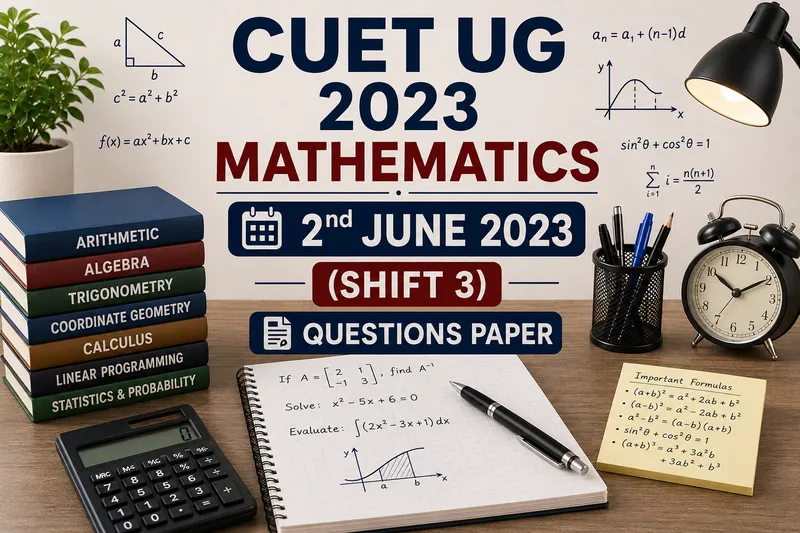
A comprehensive CUET UG Mathematics Question Paper with Solutions – 2 June 2023 (Shift 3) designed to help students practice and understand the actual CUET exam pattern. This paper covers important topics from Algebra, Calculus, Coordinate Geometry, Probability, Statistics, Matrices, Determinants, and Vectors, featuring a balanced mix of conceptual, numerical, and application-based questions. Detailed solutions are provided to strengthen problem-solving skills, improve conceptual clarity, and enhance calculation accuracy. Based on the CUET syllabus and previous year exam trends, this paper is ideal for practice, revision, self-assessment, time management, previous year analysis, and final preparation for upcoming CUET UG Mathematics examinations.
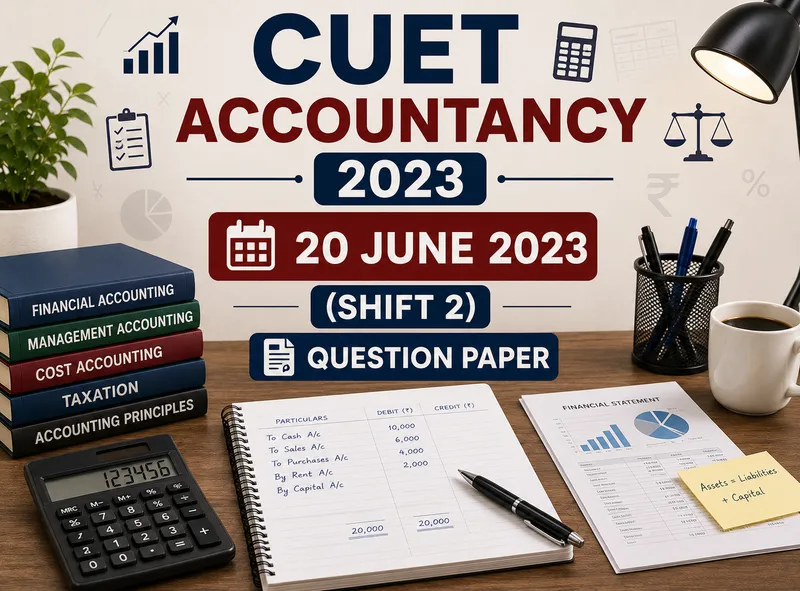
A comprehensive CUET Accountancy Question Paper – 20 June 2023 (Shift 2) designed to help students practice and analyze previous year exam patterns for effective CUET preparation. This paper covers important topics including Accounting for Partnership Firms, Company Accounts, Financial Statements Analysis, Cash Flow Statements, Accounting Ratios, and Fundamental Accounting Principles. It features a balanced mix of conceptual, numerical, and application-based questions to strengthen accounting concepts, improve calculation accuracy, and enhance problem-solving skills. Based on the CUET exam structure and syllabus, this paper is ideal for practice, revision, self-assessment, time management, previous year analysis, and final preparation for upcoming CUET Accountancy examinations.
Copyright © 2026 Combe Labs Private Limited. All Rights Reserved.