
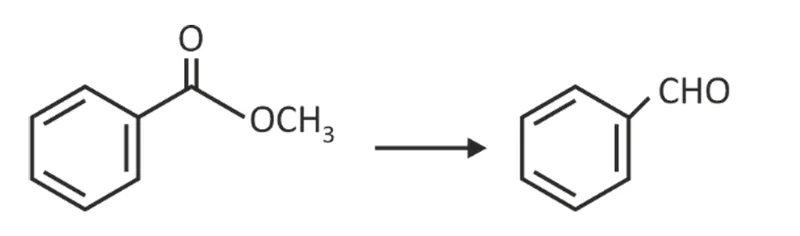
Identify the suitable reagent for the following conversion.
Solution :
The correct answer is (i) AlH(iBu)2, (ii) H2O.
Analysis of the Reaction:
1. Reactant: The starting material shown in the image is methyl benzoate (C6H5COOCH3), which is an ester.
2. Product: The product shown is benzaldehyde (C6H5CHO), which is an aldehyde.
3. Transformation: The conversion requires the selective reduction of an ester directly to an aldehyde without reducing it further to a primary alcohol.
Role of the Reagents:
1. (i) AlH(iBu)2 (Diisobutylaluminum hydride / DIBAL-H) followed by (ii) H2O:
DIBAL-H is a bulky, electrophilic reducing agent. At low temperatures (usually -78 °C), it selectively reduces esters to aldehydes. The reaction proceeds through a stable tetrahedral aluminum hemiacetal intermediate. Because of the steric bulk and low temperature, this intermediate is stable and does not collapse to an aldehyde in the reaction mixture, preventing further reduction. Upon subsequent hydrolysis (addition of H2O), the intermediate collapses to yield the aldehyde.
2. (i) NaBH4, (ii) H+/H2O:
Sodium borohydride (NaBH4) is a mild reducing agent. It reduces aldehydes and ketones but is generally not reactive enough to reduce esters under standard conditions.
3. H2/Pd-BaSO4:
This reagent combination (known as Rosenmund's catalyst) is used to reduce acid chlorides (acyl chlorides) to aldehydes, not esters.
4. (i) LiAlH4, (ii) H+/H2O:
Lithium aluminum hydride (LiAlH4) is a powerful, non-selective reducing agent. It reduces esters completely to primary alcohols (in this case, benzyl alcohol, C6H5CH2OH) rather than stopping at the aldehyde stage.
Therefore, the most suitable reagent for this conversion is (i) AlH(iBu)2, (ii) H2O.
Completely free for students. Educators & coaching institutes get 2 months free Pro trial to create tests.
Access unlimited practice questions, detailed step-by-step solutions, and exam study materials — completely free for students.
Create and conduct professional online assessments with AI question generation, tab proctoring, and comprehensive batch management.

A comprehensive JEE Advanced 2022 Paper 1 designed to help aspirants understand the examination pattern, difficulty level, and question trends of JEE Advanced. This paper covers important concepts from Physics, Chemistry, and Mathematics, featuring a balanced mix of conceptual, numerical, and advanced application-based questions. It helps students strengthen conceptual understanding, enhance analytical and problem-solving skills, and improve speed and accuracy. Ideal for practice, revision, self-assessment, previous year trend analysis, concept reinforcement, and time management, this paper is a valuable resource for effective JEE Advanced preparation.

A comprehensive JEE Advanced 2022 Paper 2 designed to help aspirants understand the examination pattern, difficulty level, and question trends of JEE Advanced. This paper covers important concepts from Physics, Chemistry, and Mathematics, featuring a balanced mix of conceptual, numerical, and advanced application-based questions. It helps students strengthen conceptual understanding, enhance analytical and problem-solving skills, and improve speed and accuracy. Ideal for practice, revision, self-assessment, previous year trend analysis, concept reinforcement, and time management, this paper is a valuable resource for effective JEE Advanced preparation.
Copyright © 2026 Combe Labs Private Limited. All Rights Reserved.


