If 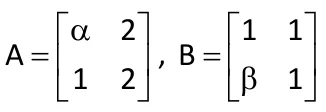 and A2 − 4A + 2I = 0, B2 − 2B + I = 0,
then |adj (A3 − B3)| is equal to
and A2 − 4A + 2I = 0, B2 − 2B + I = 0,
then |adj (A3 − B3)| is equal to
Correct Answer :
11
Solution :
The correct answer is 11.
From the given image, the matrices are defined as:
and
According to the Cayley-Hamilton theorem, any square matrix satisfies its own characteristic equation. For a 2 × 2 matrix , the characteristic equation is given by:
Step 1: Determine Matrix A
We are given that satisfies the equation:
Comparing this with the characteristic equation of :
The determinant of is:
This is consistent with the coefficient of in the equation. Therefore, matrix is:
Step 2: Determine Matrix B
We are given that satisfies the equation:
Comparing this with the characteristic equation of :
The determinant of is:
Therefore, matrix is:
Step 3: Calculate A3
From , we have:
Multiplying by :
Substituting into the equation:
Now, computing the elements of :
Step 4: Calculate B3
For a matrix of the form , its power is given by .
Thus:
Step 5: Calculate A3 - B3
Subtracting from :
Step 6: Find the Determinant of adj(A3 - B3)
For any square matrix of order , we have the property:
Since is a matrix of order :
Calculating the determinant:
Access expert-curated educational resources and study materials—completely free.
Create, conduct, and manage professional online assessments with Mindyard. Perfect for teachers and institutes.
Copyright © 2026 Mindyard. All Rights Reserved.