In a linear programming problem, if are source is not fully utilized, the shadow price of that resource is
Solution :
The correct option is zero.
In linear programming, a resource constraint is typically represented in the form:
where is the total available amount of resource i.
If a resource is not fully utilized at the optimal solution, it means that the actual usage of this resource is strictly less than the available capacity. In other words, there is leftover capacity, which is represented by a positive slack variable (). This indicates that the constraint is non-binding.
The shadow price of a resource is defined as the rate of change in the optimal objective function value per unit increase in the availability of that resource.
Since the resource is already underutilized (non-binding), acquiring more of it will not help improve the objective function value because the system does not even use the amount it currently has. Consequently, the marginal value or economic worth (shadow price) of an additional unit of this surplus resource is exactly zero.
Completely free for students. Educators & coaching institutes get 2 months free Pro trial to create tests.
Access unlimited practice questions, detailed step-by-step solutions, and exam study materials — completely free for students.
Create and conduct professional online assessments with AI question generation, tab proctoring, and comprehensive batch management.
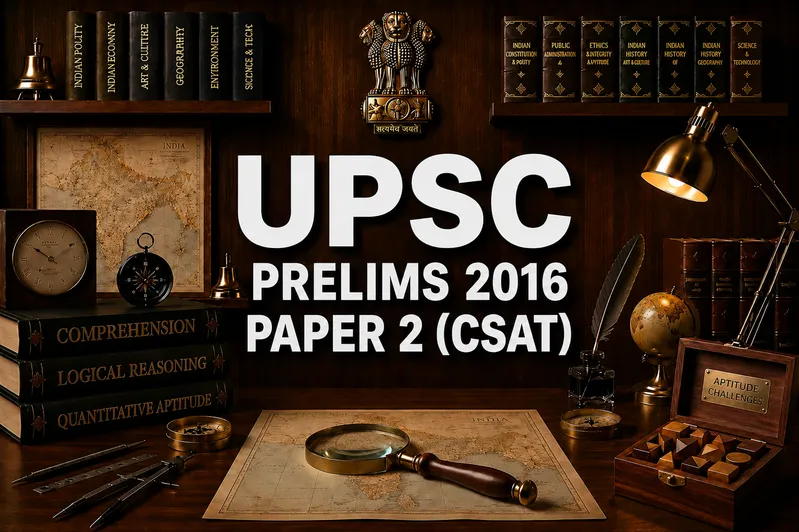
Prepare effectively for the UPSC Civil Services Examination with the UPSC Prelims 2016 Paper 2 (CSAT) Question Paper with Detailed Solutions. This paper includes all original CSAT questions from the UPSC Prelims 2016 examination along with step-by-step explanations, answer keys, and shortcut techniques.The UPSC CSAT paper tests candidates on Comprehension, Logical Reasoning, Analytical Ability, Decision Making, Basic Numeracy, Data Interpretation, and Mental Ability. Solving previous year question papers is one of the best ways to understand the exam pattern, improve accuracy, and enhance time management skills.
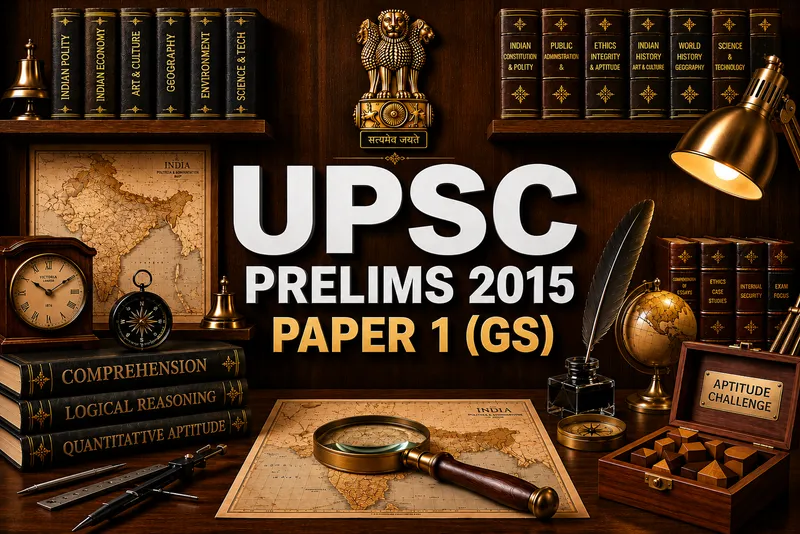
A comprehensive UPSC Prelims 2015 Paper 1 (General Studies) designed to help aspirants understand the examination pattern and strengthen their preparation for the Civil Services Examination. This paper covers important areas including History, Geography, Indian Polity, Economy, Environment and Ecology, Science and Technology, Current Affairs, and International Relations. It features a balanced mix of conceptual and application-based multiple-choice questions to enhance analytical ability, accuracy, and time management. Based on previous year trends and the UPSC examination pattern, this paper is ideal for practice, revision, self-assessment, concept reinforcement, and final preparation for the UPSC Civil Services Preliminary Examination.
Copyright © 2026 Combe Labs Private Limited. All Rights Reserved.