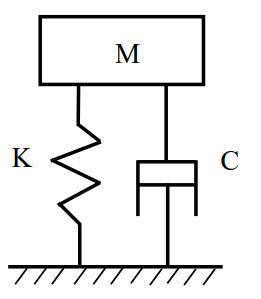
In a single degree of freedom underdamped spring-mass-damper system as shown in the figure, an additional damper is added in parallel such that the system still remains underdamped. Which one of the following statements is ALWAYS true?
Correct Answer :
Time period of free oscillations will increase.
Solution :
The correct answer is: Time period of free oscillations will increase.
Detailed Explanation:
Consider a single degree of freedom (SDOF) spring-mass-damper system with mass , spring stiffness , and initial damping coefficient , as shown in the diagram.
The undamped natural frequency of the system is given by:
where:
is the stiffness of the spring, and
is the mass.
When an additional damper is added in parallel, the equivalent damping coefficient increases:
The damping ratio () is given by:
Since the equivalent damping coefficient increases while the mass and stiffness remain constant, the damping ratio also increases. The problem states that the system remains underdamped, meaning .
The frequency of damped free oscillations () is:
As increases, the factor decreases. Consequently, the damped natural frequency decreases.
The time period of free oscillations () is defined as:
Since decreases, the time period of free oscillations must increase.
Access expert-curated educational resources and study materials—completely free.
Create, conduct, and manage professional online assessments with Mindyard. Perfect for teachers and institutes.
Copyright © 2026 Mindyard. All Rights Reserved.