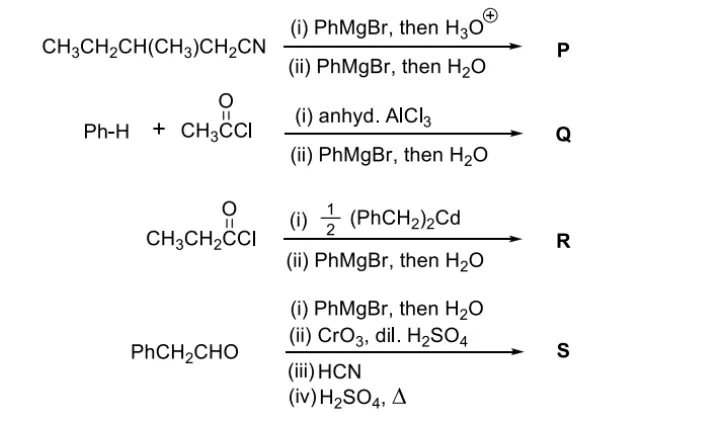
In the following reactions, P, Q, R, and S are the major products.
Correct Answer :
Both P and R have asymmetric carbon(s).
P has asymmetric carbon(s), S does not have any asymmetric carbon.
Solution :
Correct Option(s):
- Both P and R have asymmetric carbon(s).
- P has asymmetric carbon(s), S does not have any asymmetric carbon.
Let us analyze each of the given organic reaction sequences shown in the image to determine the structures of the major products P, Q, R, and S, and check whether they contain asymmetric (chiral) carbon atoms.
1. Formation and Chirality of Product P:
The starting material is (3-methylpentanenitrile), which already contains a chiral center at C3.
Step (i): Reaction with followed by acid hydrolysis () converts the nitrile group () into a phenyl ketone:
Step (ii): Reaction with a second equivalent of followed by attacks the ketone carbon to form a tertiary alcohol:
In product P, the carbon bonded to the methyl group is attached to four different groups (, , , and ). Thus, P has an asymmetric carbon.
2. Formation and Chirality of Product Q:
Step (i): Friedel-Crafts acylation of benzene () with acetyl chloride () using anhydrous gives acetophenone:
Step (ii): Nucleophilic addition of Grignard reagent () followed by workup yields 1,1-diphenylethanol:
The central carbon is attached to two identical phenyl () groups. Therefore, Q does not have any asymmetric carbon.
3. Formation and Chirality of Product R:
Step (i): Propanoyl chloride () reacts with dibenzylcadmium, , to form a ketone, 1-phenylbutan-2-one:
Step (ii): Nucleophilic addition of followed by hydrolysis gives 1,2-diphenylbutan-2-ol:
The tertiary alcohol carbon in R is attached to four distinct groups (, , , and ). Thus, R has an asymmetric carbon.
4. Formation and Chirality of Product S:
Starting material: (2-phenylacetaldehyde).
Step (i): Reaction with followed by yields 1,2-diphenylethanol:
Step (ii): Oxidation using Jones reagent () converts the alcohol into 1,2-diphenylethanone:
Step (iii): Cyanohydrin formation with produces:
Step (iv): Heating with acid () hydrolyzes the cyanohydrin nitrile group to a carboxylic acid and undergoes dehydration (elimination of water) to give the stable conjugated alkene, 2,3-diphenylacrylic acid:
All carbon atoms in product S are either part of aromatic rings, carboxylic acid carbon (), or double-bonded alkene carbons (). Therefore, S does not have any asymmetric carbon.
Conclusion:
- P: Has asymmetric carbon.
- Q: No asymmetric carbon.
- R: Has asymmetric carbon.
- S: No asymmetric carbon.
Hence, both statements "Both P and R have asymmetric carbon(s)" and "P has asymmetric carbon(s), S does not have any asymmetric carbon" are correct statements.
Access expert-curated educational resources and study materials—completely free.
Create, conduct, and manage professional online assessments with Mindyard. Perfect for teachers and institutes.
Copyright © 2026 Mindyard. All Rights Reserved.