Instructions [34 - 37 ]
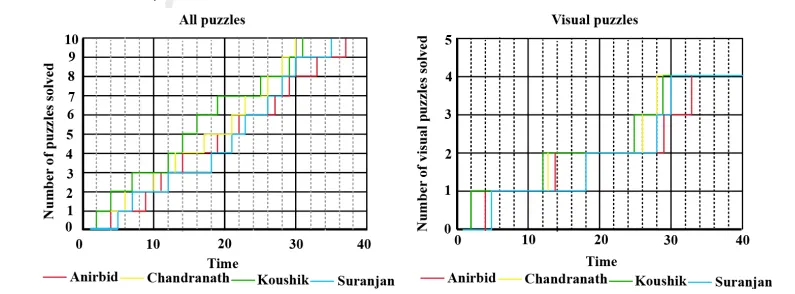
Anirbid, Chandranath, Koushik, and Suranjan participated in a puzzle solving competition. The competition comprised 10 puzzles that had to be solved in the same sequence, i.e., a competitor got access to a puzzle as soon as they solved the previous puzzle. Some of the puzzles were visual puzzles and the others were number-based puzzles. The winner of the competition was the one who solved all puzzles in the least time. The following charts describe their progress in the competition. The chart on the left shows the number of puzzles solved by each competitor at a given time (in minutes) after the start of the competition. The chart on the right shows the number of visual puzzles solved by each competitor at a given time (in minutes) after the start of the competition.
Which of the following is the closest to the average time taken by Anirbid to solve the number-based puzzles in the competition?
Solution :
Correct Answer: 4.0 minutes
To determine the average time taken by Anirbid to solve the number-based puzzles, we analyze and correlate the two step-charts provided in the image:
1. All Puzzles Chart (Left): This chart shows the cumulative number of puzzles (from 1 to 10) solved by each competitor over time (measured in minutes along the x-axis).
2. Visual Puzzles Chart (Right): This chart displays the cumulative number of visual puzzles (from 1 to 5) solved by each competitor over time.
By tracking Anirbid's progress (indicated by the red line in both charts) and looking at the transition points where each puzzle is completed, we can determine the exact time at which he solved each of the 10 sequential puzzles and identify whether each puzzle was visual or number-based.
Step 1: Identifying the Completion Times for All Puzzles (Left Chart - Red Line)
Looking at the step-up points for the red line in the "All puzzles" chart, we find the completion times for all 10 puzzles:
Step 2: Identifying the Completion Times for Visual Puzzles (Right Chart - Red Line)
From the "Visual puzzles" chart, Anirbid (red line) completes visual puzzles at the following times:
Step 3: Calculating Time Taken for Each Number-Based Puzzle
The time taken for any puzzle is the difference between its completion time and the completion time of the previous puzzle:
Step 4: Finding the Average Time
The total time spent by Anirbid on these 6 number-based puzzles is:
Since there are 6 number-based puzzles, the average time taken per puzzle is:
Thus, the closest average time taken by Anirbid to solve the number-based puzzles is 4.0 minutes.
Completely free for students. Educators & coaching institutes get 2 months free Pro trial to create tests.
Access unlimited practice questions, detailed step-by-step solutions, and exam study materials — completely free for students.
Create and conduct professional online assessments with AI question generation, tab proctoring, and comprehensive batch management.

Prepare effectively for CAT 2017 Slot 1 with this complete question paper and detailed solutions. This paper includes all sections—Verbal Ability & Reading Comprehension (VARC), Data Interpretation & Logical Reasoning (DILR), and Quantitative Aptitude (QA)—with step-by-step explanations to help you understand concepts, improve problem-solving speed, and strengthen your exam strategy. Practicing the CAT 2017 Slot 1 paper is an excellent way to experience the actual exam pattern, difficulty level, and question types asked in the Common Admission Test. This resource is ideal for MBA aspirants targeting top IIMs and other leading B-schools.

Prepare for CAT 2017 Slot 2 with the complete question paper and detailed solutions. This paper covers all three sections—Verbal Ability & Reading Comprehension (VARC), Data Interpretation & Logical Reasoning (DILR), and Quantitative Aptitude (QA)—with clear, step-by-step explanations to help you master important concepts and improve your problem-solving speed. Solving the CAT 2017 Slot 2 paper gives you valuable insight into the actual exam pattern, question types, and difficulty level of the Common Admission Test. It is an essential practice resource for MBA aspirants aiming for admission to IIMs and other top B-schools.
Copyright © 2026 Combe Labs Private Limited. All Rights Reserved.