It is the process of converting the message into communication symbols such as words, pictures, gestures etc. by the sender. Identify the process.
Solution :
The correct option is Encoding.
To understand why this is the correct answer, let's break down the communication process step-by-step:
The communication process begins with a sender who has an idea, thought, or message they wish to share. However, raw thoughts cannot be transmitted directly from one mind to another. The sender must first convert these thoughts into a symbolic form that can be transmitted and understood. This conversion process is known as encoding.
During encoding, the sender translates their internal thoughts into communication symbols. These symbols can be:
1. Words: Verbal or written language.
2. Pictures: Visual aids, diagrams, or symbols.
3. Gestures: Body language, facial expressions, or hand movements.
Let us briefly look at why the other options are incorrect:
- Decoding: This is the reverse process, where the receiver interprets and converts the received symbols back into meaningful thoughts or information.
- Translation: This refers specifically to converting text or speech from one language to another, which is only a subset of the broader encoding/decoding process.
- Dtamng: This appears to be a misspelled or meaningless term and does not represent any stage of the communication cycle.
Completely free for students. Educators & coaching institutes get 2 months free Pro trial to create tests.
Access unlimited practice questions, detailed step-by-step solutions, and exam study materials — completely free for students.
Create and conduct professional online assessments with AI question generation, tab proctoring, and comprehensive batch management.
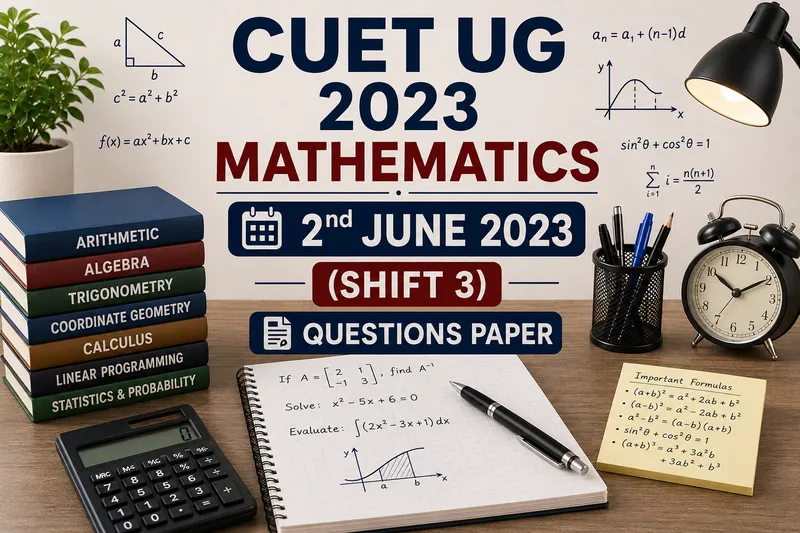
A comprehensive CUET UG Mathematics Question Paper with Solutions – 2 June 2023 (Shift 3) designed to help students practice and understand the actual CUET exam pattern. This paper covers important topics from Algebra, Calculus, Coordinate Geometry, Probability, Statistics, Matrices, Determinants, and Vectors, featuring a balanced mix of conceptual, numerical, and application-based questions. Detailed solutions are provided to strengthen problem-solving skills, improve conceptual clarity, and enhance calculation accuracy. Based on the CUET syllabus and previous year exam trends, this paper is ideal for practice, revision, self-assessment, time management, previous year analysis, and final preparation for upcoming CUET UG Mathematics examinations.
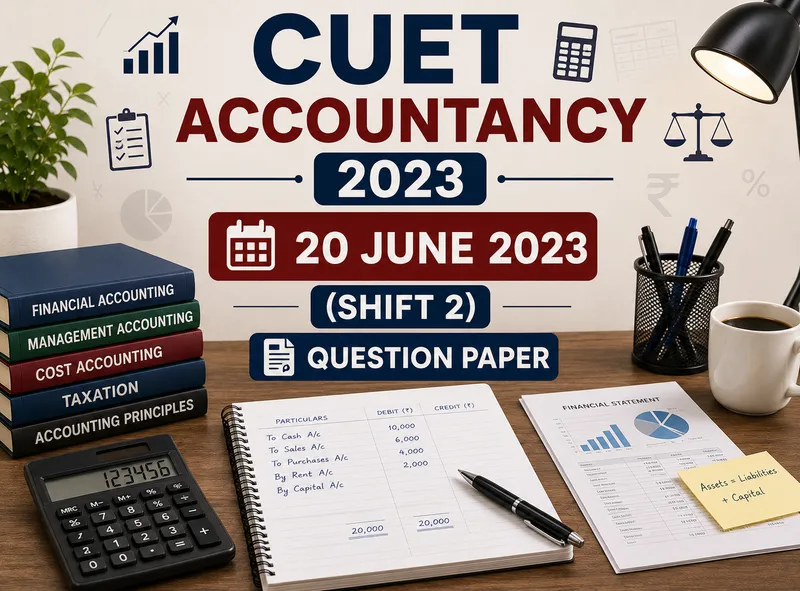
A comprehensive CUET Accountancy Question Paper – 20 June 2023 (Shift 2) designed to help students practice and analyze previous year exam patterns for effective CUET preparation. This paper covers important topics including Accounting for Partnership Firms, Company Accounts, Financial Statements Analysis, Cash Flow Statements, Accounting Ratios, and Fundamental Accounting Principles. It features a balanced mix of conceptual, numerical, and application-based questions to strengthen accounting concepts, improve calculation accuracy, and enhance problem-solving skills. Based on the CUET exam structure and syllabus, this paper is ideal for practice, revision, self-assessment, time management, previous year analysis, and final preparation for upcoming CUET Accountancy examinations.
Copyright © 2026 Combe Labs Private Limited. All Rights Reserved.