
IUPAC name is
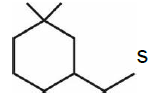
Solution :
The correct option is 3-Ethyl-1,1-dimethyl cyclohexane.
To determine the correct IUPAC name of the given compound, we analyze the structure shown in the image step-by-step:
1. Identify the parent chain/ring:
The parent structure is a six-membered saturated carbon ring, which is cyclohexane.
2. Identify the substituents:
- At the top carbon of the cyclohexane ring, there are two methyl groups () attached to the same carbon atom (a geminal dimethyl group).
- At the bottom-right carbon (located near the label 'S' in the image), there is a two-carbon chain, which is an ethyl group ().
3. Number the ring (Lowest Locant Rule):
We must assign numbers to the carbon atoms of the cyclohexane ring to give the substituents the lowest possible locants (numbers):
- Path A: If we start numbering at the carbon containing the two methyl groups as C1, the ethyl group is at C3. This gives the set of locants: (1, 1, 3).
- Path B: If we start numbering at the carbon containing the ethyl group as C1, the two methyl groups are at C3. This gives the set of locants: (1, 3, 3).
Comparing the two sets of locants at the first point of difference:
The first locant in both sets is 1. The second locant is 1 in the first set and 3 in the second set. Since 1 is lower than 3, the set (1, 1, 3) is preferred. Thus, the carbon with the two methyl groups is designated C1, and the carbon with the ethyl group is designated C3.
4. Alphabetical ordering:
When writing the name, the substituents must be listed in alphabetical order.
- "ethyl" comes alphabetically before "methyl" (note that prefix multipliers like "di-" in dimethyl are not considered when alphabetizing).
- Therefore, "3-ethyl" is written before "1,1-dimethyl".
Combining these parts, the IUPAC name is 3-Ethyl-1,1-dimethyl cyclohexane.
Completely free for students. Educators & coaching institutes get 2 months free Pro trial to create tests.
Access unlimited practice questions, detailed step-by-step solutions, and exam study materials — completely free for students.
Create and conduct professional online assessments with AI question generation, tab proctoring, and comprehensive batch management.

A comprehensive JEE Advanced 2022 Paper 1 designed to help aspirants understand the examination pattern, difficulty level, and question trends of JEE Advanced. This paper covers important concepts from Physics, Chemistry, and Mathematics, featuring a balanced mix of conceptual, numerical, and advanced application-based questions. It helps students strengthen conceptual understanding, enhance analytical and problem-solving skills, and improve speed and accuracy. Ideal for practice, revision, self-assessment, previous year trend analysis, concept reinforcement, and time management, this paper is a valuable resource for effective JEE Advanced preparation.

A comprehensive JEE Advanced 2022 Paper 2 designed to help aspirants understand the examination pattern, difficulty level, and question trends of JEE Advanced. This paper covers important concepts from Physics, Chemistry, and Mathematics, featuring a balanced mix of conceptual, numerical, and advanced application-based questions. It helps students strengthen conceptual understanding, enhance analytical and problem-solving skills, and improve speed and accuracy. Ideal for practice, revision, self-assessment, previous year trend analysis, concept reinforcement, and time management, this paper is a valuable resource for effective JEE Advanced preparation.
Copyright © 2026 Combe Labs Private Limited. All Rights Reserved.


