L ist-I contains various reaction sequences and List-II contains different phenolic compounds.
Match each entry in List-I with the appropriate entry in List-II and choose the correct option.
| List-I | List-II |
(P)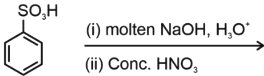 |
(1)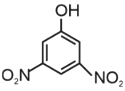 |
(Q)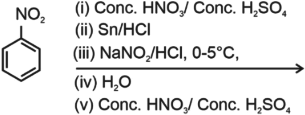 |
(2)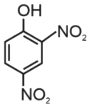 |
(R)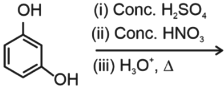 |
(3) |
(S)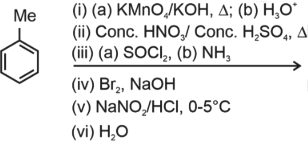 |
(4) |
(5) |
Correct Answer :
P-3, Q-5, R-4, S-1
Solution :
The correct option is P-3, Q-5, R-4, S-1.
Here is the step-by-step analysis of each reaction sequence:
1. Sequence (P):
The starting material is benzenesulfonic acid. Let's analyze the steps:
• Step (i): Treatment with molten NaOH followed by acidic workup (H3O+) replaces the sulfonic acid group (-SO3H) with a hydroxyl group (-OH) via nucleophilic aromatic substitution, yielding phenol.
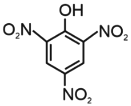
• Step (ii): Treatment of phenol with concentrated HNO3 results in nitration. Because the -OH group is highly activating and ortho/para-directing, nitration occurs at all available ortho and para positions, yielding 2,4,6-trinitrophenol (also known as picric acid). This matches compound (3).
Therefore, P-3.
2. Sequence (Q):
The starting material is nitrobenzene. Let's analyze the steps:
• Step (i): Nitration using concentrated HNO3 and concentrated H2S04 introduces a second nitro group. Since the nitro group (-NO2) is meta-directing, this yields 1,3-dinitrobenzene.
• Step (ii): Sn/HCl is a strong reducing agent that reduces both nitro groups to amino groups, converting 1,3-dinitrobenzene into benzene-1,3-diamine.
• Step (iii): Reaction with NaNO2/HCl at 0-5°C diazotizes both amino groups to form benzene-1,3-bis(diazonium) chloride.
• Step (iv): Warming with water (H2O) hydrolyzes the diazonium groups to hydroxyl groups, yielding resorcinol (benzene-1,3-diol).
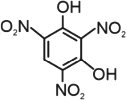
• Step (v): Nitration of resorcinol with concentrated HNO3/concentrated H2SO4 introduces nitro groups. Since the two -OH groups are meta to each other and highly activate the positions ortho and para to them, nitration occurs at positions 2, 4, and 6, yielding 2,4,6-trinitrobenzene-1,3-diol (also known as styphnic acid). This matches compound (5).
Therefore, Q-5.
3. Sequence (R):
The starting material is resorcinol. Let's analyze the steps:
• Step (i): Sulfonation using concentrated H2SO4 introduces sulfonic acid groups at the highly activated 4 and 6 positions (ortho/para relative to the -OH groups), yielding resorcinol-4,6-disulfonic acid. The sterically hindered position 2 remains unaffected.
• Step (ii): Treatment with concentrated HNO3 performs nitration at the remaining activated position 2, yielding 2-nitroresorcinol-4,6-disulfonic acid. Here, the sulfonic acid groups at positions 4 and 6 act as blocking groups.
• Step (iii): Heating with aqueous acid (H3O+, Δ) causes desulfonation, removing the sulfonic acid groups from positions 4 and 6 and leaving behind 2-nitroresorcinol (2-nitrobenzene-1,3-diol). This matches compound (4).
Therefore, R-4.
4. Sequence (S):
The starting material is toluene. Let's analyze the steps:
• Step (i): Oxidation of the methyl group using alkaline KMnO4 followed by H3O+ yields benzoic acid.
• Step (ii): Nitration with concentrated HNO3/concentrated H2SO4 under heating conditions introduces two nitro groups. Since the -COOH group is meta-directing, nitration occurs at the meta positions (3 and 5), yielding 3,5-dinitrobenzoic acid.
• Step (iii): Treatment with SOCl2 converts the carboxylic acid into an acid chloride, which then reacts with NH3 to form 3,5-dinitrobenzamide.
• Step (iv): Treatment with Br2 and NaOH triggers the Hoffmann bromamide degradation, converting the amide group (-CONH2) into an amine group (-NH2) to yield 3,5-dinitroaniline.
• Step (v): Diazotization with NaNO2/HCl at 0-5°C yields 3,5-dinitrobenzenediazonium chloride.
• Step (vi): Hydrolysis with water (H2O) replaces the diazonium group with a hydroxyl group, yielding 3,5-dinitrophenol. This matches compound (1).
Therefore, S-1.
Access expert-curated educational resources and study materials—completely free.
Create, conduct, and manage professional online assessments with Mindyard. Perfect for teachers and institutes.
Copyright © 2026 Mindyard. All Rights Reserved.