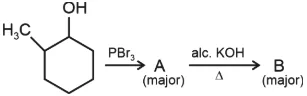
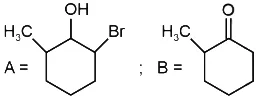
Major products A and B formed in the following , are
Options
 .
.
 .
.
 .
.
 .
.
Correct Answer :
.
Solution :
The given reaction sequence starts with 2-methylcyclohexanol:
Step 1: Formation of Product A
When 2-methylcyclohexanol is treated with phosphorus tribromide (), a nucleophilic substitution reaction occurs. The hydroxyl group () on the cyclohexane ring is replaced by a bromine atom ().
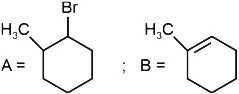
Thus, the major product A is 1-bromo-2-methylcyclohexane:
Step 2: Formation of Product B
When 1-bromo-2-methylcyclohexane (Product A) is treated with alcoholic KOH under heating (alc. KOH / Δ), it undergoes dehydrohalogenation via an E2 elimination mechanism.
The base abstracts a proton () from one of the adjacent -carbons relative to the carbon bearing the bromine atom:
1. Abstraction of a proton from the tertiary -carbon (C2, which holds the methyl group) yields a trisubstituted alkene, 1-methylcyclohexene.
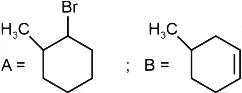
2. Abstraction of a proton from the secondary -carbon (C6) yields a disubstituted alkene, 3-methylcyclohexene.
According to Zaitsev's rule, the elimination reaction preferentially forms the more highly substituted, more stable alkene as the major product. Since a trisubstituted alkene is more stable than a disubstituted alkene, 1-methylcyclohexene is the major product.
Thus, the major product B is 1-methylcyclohexene.
Therefore, the structures corresponding to A and B are:
A = 1-bromo-2-methylcyclohexane
B = 1-methylcyclohexene
Access expert-curated educational resources and study materials—completely free.
Create, conduct, and manage professional online assessments with Mindyard. Perfect for teachers and institutes.
Copyright © 2026 Mindyard. All Rights Reserved.