Match List-I with List-II:
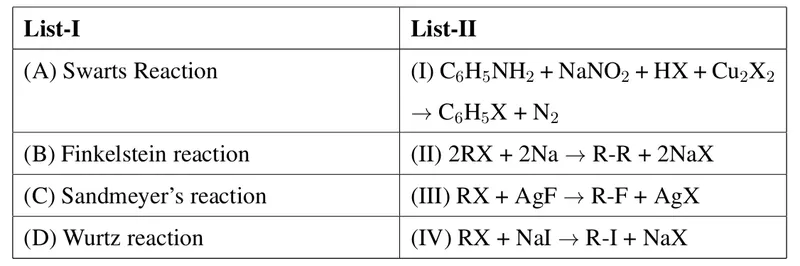
Choose the correct answer from the options given below:
Correct Answer :
(A)- (III), (B)- (IV), (C)- (I), (D)- (II)
Solution :
The correct option is (A)- (III), (B)- (IV), (C)- (I), (D)- (II).
Here is the step-by-step explanation and matching of the organic chemistry reactions listed in the image:
1. Swarts Reaction (A) matches with (III):
The Swarts reaction is a classic halogen exchange reaction used primarily for the synthesis of alkyl fluorides. It involves heating an alkyl chloride or alkyl bromide in the presence of a metallic fluoride such as silver fluoride (AgF), mercurous fluoride (Hg2F2), or cobalt fluoride (CoF2).
The general chemical equation representing this reaction is:
RX + AgF → R-F + AgX
Therefore, (A) matches with (III).
2. Finkelstein Reaction (B) matches with (IV):
The Finkelstein reaction is another halogen exchange reaction, specifically used to prepare alkyl iodides. In this reaction, alkyl chlorides or alkyl bromides are treated with sodium iodide (NaI) in the presence of dry acetone. Since NaI is soluble in acetone whereas NaCl and NaBr are precipitate out, the reaction is driven forward in accordance with Le Chatelier's principle.
The chemical equation is:
RX + NaI → R-I + NaX
Therefore, (B) matches with (IV).
3. Sandmeyer's Reaction (C) matches with (I):
Sandmeyer's reaction is a chemical reaction used to synthesize aryl halides from aniline (primary aromatic amine). Aniline (C6H5NH2) is first converted into a diazonium salt using sodium nitrite (NaNO2) and a hydrogen halide (HX) at low temperatures. The diazonium group is then replaced by a halide ion using copper(I) halide (Cu2X2) as a catalyst, releasing nitrogen gas (N2).
The overall represented equation is:
C6H5NH2 + NaNO2 + HX + Cu2X2 → C6H5X + N2
Therefore, (C) matches with (I).
4. Wurtz Reaction (D) matches with (II):
The Wurtz reaction is a coupling reaction in organic chemistry where two molecules of alkyl halides (RX) react with sodium metal in the presence of dry ether to form a symmetrical higher alkane (R-R) containing double the number of carbon atoms.
The chemical equation is:
2RX + 2Na → R-R + 2NaX
Therefore, (D) matches with (II).
Conclusion:
Matching the pairs:
• (A) → (III)
• (B) → (IV)
• (C) → (I)
• (D) → (II)
Access expert-curated educational resources and study materials—completely free.
Create, conduct, and manage professional online assessments with Mindyard. Perfect for teachers and institutes.
Copyright © 2026 Mindyard. All Rights Reserved.